2,740만 개의 줄이 있다.
하나하나가 한 번의 수입이다. 어떤 줄은 장난감이고, 어떤 줄은 알루미늄 코일이고, 어떤 줄은 이름을 들어도 무엇인지 모를 부품이다. 줄마다 날짜가 있고, 금액이 있고, 품목 번호가 있다. 그리고 줄의 어딘가에 아홉 자리로 시작하는 번호가 하나 더 적혀 있다.
9903.
그 번호가 적혀 있으면 돈이 돌아온다. 비어 있거나 잘못 적혀 있으면 돌아오지 않는다.
판결문에는 그런 조건이 없었다.
2026년 2월 20일, 미국 연방대법원은 6대 3으로 판단했다. 국제비상경제권한법(IEEPA)은 대통령에게 관세를 부과할 권한을 주지 않는다. 로버츠 대법원장은 그 법 어디에도 관세라는 말이 없다고 썼다. 나흘 뒤 정부는 징수를 멈췄다.
그날 이후 여덟 달이 지났다. 그동안 그 2,740만 개의 줄에서 일어난 일은, 판결이 아니라 서류의 일이었다.
① 세계의 시선 — 모두가 금액을 세고 있다
워싱턴의 법률 시장은 금액을 센다. 1,366억 달러. 2026년 10월 2일 기준으로 환급 신청이 접수된 규모다. 역대 최대 규모의 관세 환급이라는 표현이 붙는다. 기사의 주인공은 수입업자이고, 동사는 ‘이겼다’다.
정부는 권한을 말한다. 법무부와 세관국경보호청(CBP)의 서면은 금액을 다투지 않는다. 다투는 것은 누구에게, 어떤 명령으로 돌려주느냐다. 청산이 끝난 건에 대해 세관은 “법원의 명령 없이 재청산하거나 환급할 권한이 없다”는 입장을 유지한다. 소송을 제기하지 않은 수입자에게까지 구제를 확대할 권한이 법원에 있는지도 다툰다.
시장은 날짜를 센다. 수입업자와 관세사들이 보는 것은 금액이 아니라 시한이다. 펜타닐 관세 건은 2027년 2월 4일, 상호 관세 건은 2027년 4월 5일. 그날이 지나면 법원으로 가는 문이 닫힌다.
세 개의 시선은 서로 다른 것을 센다. 그런데 하나를 똑같이 전제한다.
판결이 났으니 돈은 돌아온다. 남은 문제는 얼마와 언제다.
그래서 아무도, 금액이 확정되고 수령자까지 확정됐는데도 움직이지 않고 있는 13억 달러를 세지 않는다.
② 또 하나의 세계 — 돈이 멈춰 선 여섯 개의 자리
첫째. 걷을 때는 아무도 신청하지 않았다
이 사건의 비대칭은 여기서 시작한다. 관세가 걷힐 때 수입자가 한 일은 없다. 세관이 계산하고 세관이 걷었다. 돌려줄 때는 반대다. 수입자가 신청해야 한다. 신청하지 않으면 돈은 국고에 남는다.
위법은 국가의 행위였고, 환급은 기업의 숙제다.
둘째. 같은 위법, 세 개의 문
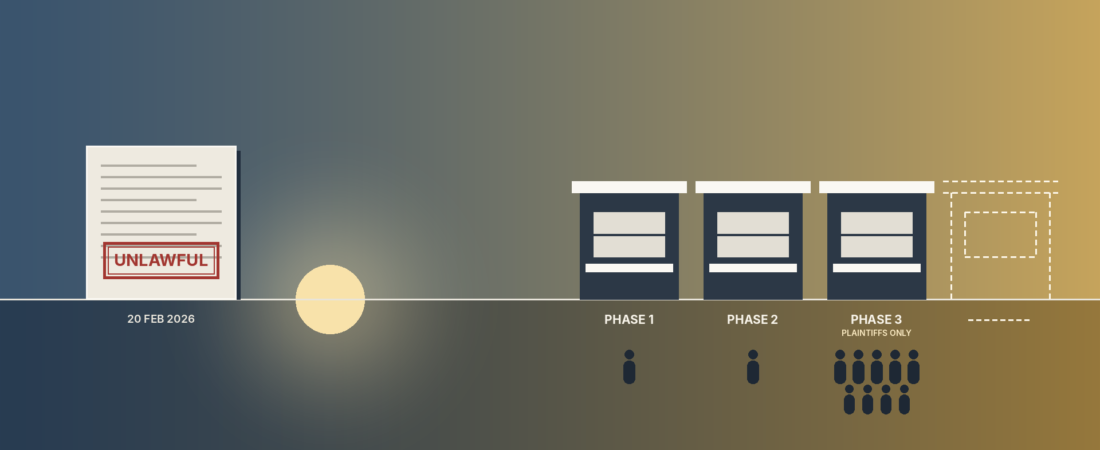
세관은 환급을 한 번에 열지 않았다. ACE 전산망 안에 ‘CAPE’라는 절차를 만들고 단계별로 열었다. 1단계는 2026년 4월 20일, 아직 청산되지 않은 건과 청산 후 80일이 지나지 않은 건. 2단계는 6월 29일, 재대조 표시가 붙은 건. 3단계는 10월 6일, 청산 후 80일을 넘긴 건.
3단계에는 조건이 하나 더 붙었다. 법원에 소송을 제기한 원고만 쓸 수 있다. 그리고 2026년 7월 30일까지 수입자 등록번호를 세관에 제출했어야 한다.
같은 날 같은 관세를 냈고 같은 판결로 이겼는데, 어느 문으로 들어갈 수 있는지는 사람마다 다르다.
셋째. 90일이 자격을 만든다
왜 80일에서 끊었는가. 미국 법은 세관이 스스로 청산을 되돌릴 수 있는 기간을 청산 후 90일로 정해 두었다(19 U.S.C. § 1501). 그 창이 닫히면 세관은 자기 판단으로 돈을 돌려줄 수 없다. 법원이 명령해야 한다.
그 조항은 본래 세관이 자기 실수를 조용히 고치기 위한 장치였다. 한 건, 두 건을 되돌리는 문이다. 이번에는 2,740만 개의 줄이 그 문 앞에 섰다.
80일은 그래서 90일에서 열흘을 뺀 숫자다. 처리에 걸리는 시간을 남겨 둔 간격이다. 제도의 여유분이 수입자의 자격이 됐다.
넷째. 코드가 없으면 증명할 수 없다
환급을 신청하려면 그 수입 건이 문제의 관세에 해당한다는 것을 보여야 한다. 그 증거가 관세율표 99장의 번호다. 9903.01로 시작하는 줄, 9903.02로 시작하는 줄. 국가별로 끝 두 자리가 갈린다.
10월 2일 기준으로 접수된 신청은 297,887건이고, 검증을 통과한 것은 209,262건이다. 통과하지 못한 수입 건은 620만 건에 달한다. 사유는 세 가지로 모인다. 재청산 기간이 이미 지났거나, 99장 번호가 누락됐거나, 앞서 낸 신청과 겹친다.
걷을 때 그 칸이 비어 있어도 관세는 걷혔다. 돌려받을 때 그 칸이 비어 있으면 돈은 돌아오지 않는다.
입증의 방향이 뒤집혔다.
다섯째. 13억 달러가 계좌를 기다린다
세관이 9월 15일 법원에 제출한 서면에는 한 줄이 들어 있다. 환급액이 확정됐는데도 지급되지 못한 신청이 20,184건, 약 13억 달러. 사유는 하나다. 받을 계좌 정보가 등록돼 있지 않다.
이 돈은 다투는 돈이 아니다. 위법도 금액도 수령자도 끝난 돈이다. 제도가 할 일을 다 한 자리에서 멈춰 있다.
같은 서면의 다른 줄은 더 큰 숫자를 말한다. 접수액 1,347억 달러 중 이자를 포함한 약 1,220억 달러가 재무부로 넘어가 지급 승인을 받았다. 두 숫자의 간격이 이 제도의 실제 진도다.
여섯째. 창구가 아예 없는 사람들
반덤핑·상계관세가 함께 부과된 건은 환급 장치가 없다. 최종 세율이 확정되기까지 수년이 걸릴 수 있어서다. 이 집단에 관한 서면 제출 기한은 10월 19일, 정부 답변은 11월 9일로 정해져 있다.
그리고 10월 8일, 국제무역법원의 이튼 판사가 결정 하나를 냈다. 2025년 2월 1일부터 2026년 2월 19일 사이에 문제의 관세를 납부한 모든 수입자를 하나의 집단으로 인증했다. 따로 소송을 낸 법인은 제외된다. 이 결정이 유지되면, 소송하지 않은 수입자도 개별 청구 없이 환급을 받을 수 있다.
10월 6일에 열린 세 번째 문은 소송을 낸 사람만 쓸 수 있었다. 이틀 뒤 법원은 소송하지 않은 사람들의 길을 열었다.
제도가 스스로를 이틀 만에 추월했다. 그리고 그 결정은 아직 항소를 기다린다.
③ AURA의 시선
기업에게. 계약서는 환급을 다루지 않는다. 관세 조항은 대개 “누가 부담하는가”까지만 적혀 있다. 그 관세가 위법으로 판정돼 돌아올 때 누구의 돈이 되는지는 적혀 있지 않다. 가격을 깎아 흡수했든, 인코텀즈로 떠안았든, 추가 비용으로 나눠 냈든, 그 사실은 세관의 기록에 남지 않는다.
세관의 기록에 남는 것은 한 사람이다. 수입자 등록번호를 가진 자. 환급을 신청할 수 있는 것은 그 사람과 그 건을 접수한 통관 대리인뿐이다. 공급망의 다른 당사자는 이 창구를 쓸 수 없다.
그러므로 관세를 실제로 부담한 사람과 환급을 신청할 수 있는 사람은 같은 사람이 아니다. 한국에서 미국으로 보내는 수출기업 대부분은 미국의 수입자가 아니다. 그들에게는 창구가 없다. 계약서만 있다.
투자자에게. 숫자는 금액이 아니라 비율로 읽어야 한다. 접수 1,347억 달러 대비 지급 승인 1,220억 달러. 접수 297,887건 대비 통과 209,262건. 전자는 청구고 후자는 확정이다. 분자와 분모가 다르면 같은 사건도 다르게 보인다.
실무에게. 세관이 환급 대상을 찾는 데 쓰는 것은 전산 기록이다. 그런데 같은 기록으로 세관은 반대 방향도 본다. 분류·과세가격·원산지의 이상 징후를 데이터로 찾아내 정보 요청서를 보내는 일이 늘고 있다. 한 건에 대한 판단은 유사한 모든 수입 건에 적용될 것을 전제한다.
같은 데이터베이스가 돈을 돌려주기도 하고 돈을 더 걷기도 한다. 환급 신청은 그 데이터베이스에 스스로 손을 들어 보이는 행위이기도 하다.
정책에게. 여기서는 답하지 않는다. 다만 조항 하나를 다시 읽어 둔다. 법은 세관에게 90일을 주었다. 그것은 세관이 한 건의 실수를 고치기 위한 기간이었다. 1년 넘게 이어진 제도를 되돌리는 데 쓰라고 만든 창이 아니다.
그 조항을 쓸 때 입법자는 2,740만 개의 줄을 상정하지 않았다. 그렇다면 묻는다. 위법한 제도를 되돌리는 절차는, 그 제도를 만들 때와 같은 급의 설계를 받아야 하는가.
AURA Insight
세관이 3월 6일 법원에 제출한 숫자는 약 1,660억 달러였다. 33만 명이 넘는 수입업자에게 돌려줘야 할 돈이고, 즉시 지급은 불가능하다고 했다.
여덟 달 뒤 신청된 금액은 1,366억 달러다. 두 숫자는 기준이 다르다. 하나는 세관이 추정한 징수 규모이고, 하나는 수입자가 실제로 접수한 청구액이다. 그래서 단순히 뺄 수 없다. 다만 간격이 작지 않다는 것은 보인다.
신고 건수와 수입업자 수는 더 조심해야 한다. 297,887과 33만은 나란히 적어도 뺄 수 없는 숫자다. 한쪽은 신고를 세고 한쪽은 사람을 센다. 단위가 다른 두 숫자를 나란히 두는 순간 기사는 틀리기 시작한다.
그럼에도 이 사건이 가르쳐 주는 것은 분명하다. 판결은 한 번에 났고, 창구는 하나씩 열렸다. 그리고 창구마다 다른 사람이 서 있었다.
우리는 제도가 굳는 과정을 본 적이 있다. 금지가 명단이 되고, 명단이 허가가 되고, 허가가 요금이 되는 순서다. 이번에 본 것은 그 반대 방향이다. 제도가 위법으로 판정돼도 사라지지 않는다. 풀리는 데에도 창구가 필요하고, 그 창구는 들어올 때보다 좁다.
세계를 이해하는 일은 더 많은 뉴스를 읽는 일이 아니다. 이겼다는 말과 받았다는 말 사이에 무엇이 들어 있는지를 아는 일이다.
AURA Question
당신의 일에도, 이미 이겼다고 적혀 있는데 아직 통장에 들어오지 않은 것이 있지 않은가.
함께 읽으면 좋은 글
- EP.013 — 요금표가 없는 톨게이트
- 관세란 무엇인가 — 관세가 오르면 소비자 가격은 어떻게 될까
- AURA Mystery EP.003 — 관세는 왜 항상 12시 1분에 발효되는가
- 보복관세 발효일, 우리 화물도 대상일까 — 실무자가 확인할 5가지
- L/C와 D/A·D/P는 무엇이 다른가 — 서류를 무엇과 바꾸는가의 차이
- 수출신고필증, 어느 금액이 우리 매출인가
- EP.004 — 1930년의 유령
English Edition — The Winners Line Up Again
Three Perspectives, EP.014 — On what a judgment does not do
There are 27.4 million lines.
Each one is an import. Some are toys. Some are aluminium coils. Some are parts whose names tell you nothing. Every line carries a date, a value, a commodity number. And somewhere on the line sits one more code, beginning with four digits.
9903.
If the code is there, the money comes back. If the field is empty or wrong, it does not.
The judgment set no such condition.
On 20 February 2026, the Supreme Court of the United States held, six to three, that the International Emergency Economic Powers Act does not give the president the power to impose tariffs. The Chief Justice noted that the statute never mentions tariffs at all. Four days later, the government stopped collecting.
Eight months have passed. What has happened to those 27.4 million lines since then has not been the work of a court. It has been the work of paperwork.
I. The Global Gaze — Everyone Is Counting Money
Washington’s legal market counts dollars. As of 2 October 2026, refund claims filed came to roughly $136.6 billion. The phrase attached to it is “the largest tariff refund in history.” The subject of the sentence is the importer, and the verb is “won.”
The government speaks of authority. The filings by the Justice Department and Customs and Border Protection do not dispute the amount. They dispute who gets paid, and under whose order. For entries already liquidated, the agency’s position holds that it has no authority to reliquidate or refund without a court order. Whether a court may extend relief to importers who never sued is itself contested.
The market counts dates. What importers and brokers watch is not the sum but the deadline: 4 February 2027 for fentanyl-tariff entries, 5 April 2027 for reciprocal-tariff entries. After that, the door to the courthouse closes.
Three gazes, counting three different things. Yet all three rest on the same assumption.
The judgment has come, so the money will return. What remains is how much, and when.
Which is why no one counts the $1.3 billion that has been fixed in amount, assigned to a named recipient, and has not moved.
II. The Other World — Six Places Where the Money Stopped
One. Nobody applied in order to pay. The asymmetry starts here. When the tariff was collected, the importer did nothing. The agency calculated, and the agency collected. Going the other way, the importer must file. If no one files, the money stays in the Treasury. The illegality was the state’s act. The refund is the company’s homework.
Two. One illegality, three doors. Refunds did not open at once. Inside the ACE system, a process called CAPE opened in stages. Phase 1 on 20 April 2026, for unliquidated entries and those liquidated within eighty days. Phase 2 on 29 June, for reconciliation-flagged entries. Phase 3 on 6 October, for entries liquidated more than eighty days earlier — and only for plaintiffs who had filed suit, and who had given the agency their importer-of-record number by 30 July 2026. Same tariff, same day, same judgment. Different door.
Three. Ninety days makes eligibility. Why eighty days? Because the statute allows the agency ninety days from liquidation to reliquidate on its own motion. Once that window shuts, it cannot act without a court. That provision was built so that customs could quietly correct its own mistakes — one entry, two entries. This time, 27.4 million lines queued at that door. Eighty is ninety minus ten: the margin left for processing. An administrative buffer became a legal qualification.
Four. Without the code, you cannot prove it. To claim, you must show the entry carried the tariff at issue. The evidence is a Chapter 99 number. Of 297,887 claims filed as of 2 October, 209,262 passed validation; some 6.2 million entries did not. The reasons converge: the reliquidation window had closed, the Chapter 99 line was missing, or the filing duplicated an earlier one. An empty field did not stop the money from being taken. An empty field does stop it from coming back. The burden of proof has reversed.
Five. $1.3 billion waiting for a bank account. A declaration filed with the court on 15 September carries one line: 20,184 claims, about $1.3 billion, determined but unpaid. The reason is singular — no account on file. This is not contested money. The illegality, the amount and the recipient are all settled. It has stopped at the point where the system had finished its work. Another line in the same filing is larger: of $134.7 billion claimed, roughly $122 billion including interest has been certified and transmitted to the Treasury. The gap between those two numbers is the real progress of this programme.
Six. The people with no window at all. Entries that also carried antidumping or countervailing duties have no refund mechanism, because final rates can take years to settle. Briefing on that group is due 19 October, with the government’s response on 9 November. Then, on 8 October, Judge Eaton of the Court of International Trade certified a class: every importer of record that paid the challenged tariffs between 1 February 2025 and 19 February 2026, excluding those that sued separately. If it holds, importers who never filed can be refunded without individual claims. The third door, opened on 6 October, was for plaintiffs only. Two days later the court opened a path for everyone else. The system overtook itself in forty-eight hours — and that ruling still awaits appeal.
III. The AURA Perspective
For companies. Contracts do not address refunds. A tariff clause usually goes as far as who bears the cost. It does not say whose money it becomes when that cost is ruled unlawful and returns. Whether you absorbed it in price, carried it through Incoterms, or split it as a surcharge, none of that appears in the customs record. What appears there is one party: the holder of the importer-of-record number. Only that party, or the broker who filed the entry, may claim. No other link in the chain may use this window. So the party that bore the tariff and the party that may claim it back are not the same party. Most exporters shipping into the United States are not the importer of record. They have no window. They have a contract.
For investors. Read ratios, not totals. $122 billion certified against $134.7 billion claimed. 209,262 validated against 297,887 filed. The first number is a claim; the second is a determination. Change the numerator and the same event reads differently.
For practitioners. The agency finds refundable entries in its electronic records. It reads the same records in the opposite direction. Requests for information are rising as data analysis flags anomalies in classification, valuation and origin, and a single determination is expected to be applied across all similar entries. The same database returns money and collects more of it. Filing a claim is also an act of raising your hand to that database.
For policy. We leave this one open. But reread the provision. The law gave customs ninety days. It was meant for correcting one mistake. It was not built to unwind a regime that ran for more than a year. Whoever wrote it did not have 27.4 million lines in mind. So: should the procedure for undoing an unlawful system be designed with the same care as the system itself?
AURA Insight
On 6 March the agency told the court the figure was about $166 billion, owed to more than 330,000 importers, and that immediate payment was impossible. Eight months later, the amount claimed is $136.6 billion. The two figures rest on different bases — one an estimate of what was collected, the other what was actually filed — so they cannot simply be subtracted. The gap is visible all the same.
Claim counts and importer counts demand more care still. 297,887 and 330,000 cannot be subtracted even when printed side by side. One counts filings; the other counts people. Set two different units next to each other and the article begins to be wrong.
Still, the lesson is clear enough. The judgment came once. The windows opened one at a time. And a different person stood at each one.
We have watched a regime harden before: a prohibition becomes a list, a list becomes a permit, a permit becomes a price. This time we watched the other direction. A regime ruled unlawful does not vanish. Undoing it also requires a window, and that window is narrower than the one you came in through.
Understanding the world is not reading more news. It is knowing what sits between the word “won” and the word “received.”
AURA Question
In your own work, is there something already recorded as won that has still not reached the account?
Sources
사실 (1차 자료 및 법원·당국 제출 문서에 근거)
- 미국 연방대법원, Learning Resources, Inc. v. Trump(Trump v. V.O.S. Selections, Inc. 병합), 2026년 2월 20일 선고, 6대 3. IEEPA는 관세 부과 권한을 부여하지 않는다는 판시. 환급 방법은 판단 대상이 아니었다.
- 하급심 경과: 국제무역법원 3인 합의부 약식판결(2025년 5월 28일), 연방순회항소법원 전원합의체(2025년 8월 29일), 대법원 변론(2025년 11월 5일).
- 2026년 2월 24일 IEEPA 관세 예치금 징수 중단. 2026년 3월 4일 국제무역법원 이튼 판사, 납부 수입업자의 이자 포함 환급 권리 인정.
- 2026년 3월 6일 CBP 법원 제출: 약 1,660억 달러·33만 명 이상 수입업자에 대한 즉시 환급은 불가능.
- CAPE(Consolidated Administration and Processing of Entries, ACE 내 운영): 1단계 2026년 4월 20일(미청산 및 청산 후 80일 이내), 2단계 2026년 6월 29일(재대조 표시 건), 3단계 2026년 10월 6일(청산 후 80일 초과, 소송 원고 한정, 2026년 7월 30일까지 IOR 번호 제출 요건).
- CBP가 2026년 9월 15일 국제무역법원에 제출한 선언문: 신고 28만 6,000건 이상 접수, 20만 1,000건 이상 처리 승인, 약 2,720만 수입 건, 접수액 약 1,347억 달러, 이자 포함 약 1,220억 달러 재무부 송부·지급 승인, ACH 계좌 정보 미제공으로 보류 20,184건·약 13억 달러.
- 2026년 10월 2일 기준 집계: 신고 297,887건 접수, 209,262건 검증 통과, 약 2,740만 수입 건, 약 1,366억 달러. 검증 실패 수입 건 약 620만 건. 실패 사유 — 재청산 기간 초과, IEEPA 해당 관세율표 99장 번호 누락, 기존 신고와 중복.
- 19 U.S.C. § 1501: 청산 후 90일 내 세관의 임의 재청산. 재청산 후 이의제기(protest) 기한 180일.
- 신청 자격: 원래 관세를 납부한 수입자 등록번호(IOR) 보유자 또는 해당 건을 접수한 관세사. 공급망의 제3자는 CAPE로 청구할 수 없다.
- 환급 대상 범위: 펜타닐 관세 2025년 2월 4일~2026년 2월 24일 납부분, 상호 관세 2025년 4월 5일~2026년 2월 24일 납부분. 관세율표 99장 코드 9903.01·9903.02 계열.
- 국제무역법원 소송 제기 시한: 펜타닐 관세 건 2027년 2월 4일, 상호 관세 건 2027년 4월 5일.
- Freestyle World v. United States, slip op. 26-123, No. 26-1088(국제무역법원, 2026년 10월 8일, 이튼 판사): 2025년 2월 1일~2026년 2월 19일 사이 문제의 관세를 납부한 모든 수입자 등록번호 보유자를 집단으로 인증. 별도 소송 제기 법인은 제외. 2026년 10월 13일 비공개 현황 회의 예정.
- 반덤핑·상계관세 중복 건(이른바 ‘type three’): 환급 장치 미비. 서면 제출 기한 2026년 10월 19일, 정부 답변 2026년 11월 9일.
- CBP의 정보 요청서(CF-28) 발송 증가: 데이터 분석으로 분류·과세가격·원산지 이상 징후를 탐지. 한 건의 결정은 유사 수입 건 전체에 적용될 것을 전제.
해석 (AURANIM 편집부)
- “징수는 자동이고 환급은 신청이다”, “입증의 방향이 뒤집혔다”, “제도가 스스로를 추월했다”, “풀리는 데에도 창구가 필요하고 그 창구는 들어올 때보다 좁다”는 편집부의 구조 정리이며 당국·법원의 용어가 아니다.
- 80일을 “90일에서 처리 시간 열흘을 뺀 간격”으로 읽은 것은 편집부의 해석이다. CBP가 80일을 택한 사유를 명시한 공개 문서는 확인하지 못했다.
- 약 1,660억 달러와 약 1,366억 달러의 간격을 “미신청분”으로 단정하지 않았다. 두 숫자는 기준(징수 추정액 vs 접수 청구액)과 시점이 다르다.
- 297,887건과 33만 명을 뺄 수 없다고 본 것은 단위 판단이다. 신고 건수와 수입업자 수는 서로 다른 단위다.
- “관세를 부담한 사람과 환급을 신청할 수 있는 사람은 같은 사람이 아니다”는 신청 자격 규정에서 도출한 편집부의 정리다. 개별 거래의 비용 귀속은 계약에 따라 달라진다.
- 오프닝의 “2,740만 개의 줄”은 집계된 수입 건수를 장면으로 옮긴 서술이며, 특정 기업·특정 신고 건을 가리키지 않는다.
불확실 (확인하지 못한 것)
- CBP 공식 홈페이지의 IEEPA 환급 안내 페이지는 취득에 실패해(접근 오류) 확인하지 못했다. 본문의 당국 수치는 CBP가 국제무역법원에 제출한 서면을 인용한 2차 자료를 복수 대조해 썼다.
- 검증 실패 620만 건의 사유별 내역(각 사유가 몇 건인지)은 공개 자료에서 확인하지 못했다.
- 이자 산정 방식과 적용 요율은 확인하지 못했다. “이자 포함”이라는 서술은 당국 서면의 표현에 따른다.
- 집단 인증에 대한 정부의 항소 여부는 집필 시점까지 확인되지 않았다. 10월 13일 현황 회의는 비공개여서 결과를 알 수 없다.
- 집단 인증이 적용될 경우의 지급 경로(CAPE 사용 여부)와 기한은 정해지지 않았다.
- 본문의 금액은 모두 미국 달러이며, 환율 환산은 하지 않았다. 환산 시점에 따라 원화 금액이 달라지기 때문이다.
※ 이 글은 특정 환급 절차의 이용이나 소송 제기를 권유하지 않는다. 제도와 기한은 법원의 판단과 당국의 공지에 따라 바뀔 수 있으므로, 실제 신청과 대응은 반드시 해당 시점의 공식 공지와 전문가 확인을 거쳐야 한다.