Read this article in English ↓
세계(世界)를, 세 개(三個)의 시선으로 읽는다.
울산은 조용하고, 배는 반대로 온다. 한국 수출 1번지에 찾아온 조용한 겨울의 이야기.
Introduction — 7월의 울산
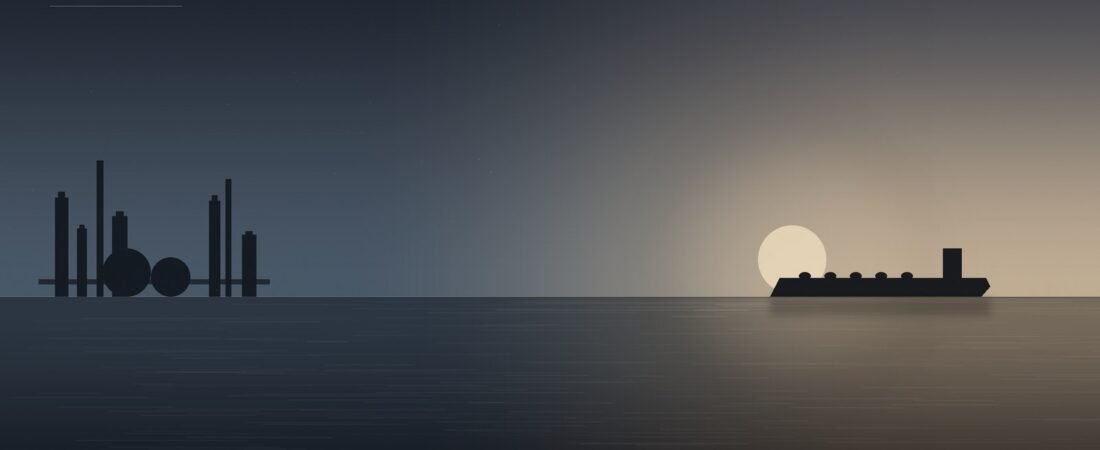
7월의 어느 오후, 울산 석유화학단지. 은빛 증류탑들은 여전히 하늘을 찌르고 있다. 그런데 뭔가 다르다. 도로가 한산하다. 탱크로리의 행렬이 짧아졌다. 단지를 오래 드나든 사람들은 안다. 이곳의 활기는 소리로 느껴지는 것이었다. 그 소리가 줄었다.
같은 시각, 울산항. 배 한 척이 들어온다. 실려 있는 것은 중국 공장에서 만든 아크릴산이다. 한국 고객사로 갈 화물이다.
여기서 이상한 점을 발견한 사람이 있을 것이다. 아크릴산은 한국 회사도 만든다. 바로 이 단지에서, 수십 년째. 그런데 배는 반대로 온다. 한국이 중국에 팔던 제품이, 이제 중국에서 한국으로 들어온다.
무슨 일이 벌어지고 있는 걸까. 울산은 왜 조용해졌을까.
이것은 한 도시의 이야기가 아니다. 한국 제조업의 방향이 바뀌는 소리이고, 어쩌면 세계 산업 지도가 다시 그려지는 소리다. 세 개의 시선으로 따라가 보자.
① 세계의 시선 — Global Perspective
이것은 한국만의 이야기가 아니다
세계 산업 분석가들의 눈에, 지금 석유화학은 전 지구적 위기 산업이다. 에너지 컨설팅사 우드매켄지는 이 상황을 “공급과잉이 산업의 생존을 위협한다”고 표현했다. 과장이 아니다. 숫자가 그렇게 말한다.
유럽부터 보자. 엑슨모빌은 프랑스의 크래커(석유화학의 심장인 기초원료 공장)를 닫았다. 사빅은 네덜란드에서, 베르살리스는 이탈리아에서 설비를 접었다. 업계 분석기관 ICIS는 유럽의 크래커 폐쇄를 아예 별도 페이지로 추적하고 있다. 일본도 크래커 통합과 재편을 논의 중이다. 40년을 돌아가던 공장들이 몇 년 사이에 연달아 멈추고 있는 것이다.
서방 언론의 프레임은 대체로 ‘서구 산업의 쇠퇴’다. 높은 에너지 비용, 탄소 규제, 그리고 아시아의 저가 공세. 유럽의 이야기에서 한국의 이름은 잘 등장하지 않는다. 그러나 원인의 지도를 그려 보면, 모든 화살표가 한 곳에서 출발한다.
모든 화살표는 중국에서 출발한다
중국은 지난 몇 년간 인류 역사상 최대 규모의 석유화학 증설을 진행했다. 그 결과 에틸렌을 비롯한 범용 제품의 자급률이 100%에 다가섰다. 세계 최대 수입국이 세계 최대 생산국이 된 것이다.
수입하던 나라가 자급하면, 수출하던 나라들의 시장이 사라진다. 여기까지는 산수다. 문제는 그다음이다. 중국의 새 공장들은 자급을 넘어 수출을 시작했다. 세계의 공급은 수요보다 훨씬 커졌고, 가격은 원가 밑으로 내려갔다. 유럽의 크래커가 닫히고, 일본이 재편하고, 울산이 조용해진 이유는 결국 같은 문장으로 요약된다. 세계에 공장이 너무 많다.
② 또 하나의 세계 — The Other World
울산 — 소리가 줄어든 단지
숫자로 보면 이렇다. 한국 석유화학 업계는 최근 조 단위의 적자를 쌓았다. 수익성을 가늠하는 에틸렌 스프레드(제품 가격에서 원료 값을 뺀 것)는 몇 년째 손익분기점을 밑돌고, 2026년 들어서는 두 달 사이 반토막이 나며 역마진 공포까지 번졌다.
그래서 정부와 업계는 한국 석유화학의 심장인 NCC 생산능력을 18~25%, 연 270만~370만 톤 줄이는 구조조정에 들어갔다. 대산에서는 110만 톤 설비가 가동을 멈췄다. 여수에서는 47만 톤 공장이 폐쇄됐다. 그리고 울산에서는 66만 톤 NCC의 폐쇄안이 논의되고 있다.
통계는 차갑지만, 현장의 변화는 구체적이다. 출하가 줄면 탱크로리가 줄고, 탱크로리가 줄면 단지 앞 식당의 점심 손님이 준다. 협력업체의 일감이 줄고, 정비 인력의 일정표가 비기 시작한다. 산업의 겨울은 뉴스보다 먼저 거리에 도착한다.
역류 — 국산이 있는데, 배는 반대로 온다
그리고 이 겨울에는 낯선 장면이 하나 추가됐다. 서두의 그 배다.
아크릴산은 기저귀의 흡수체부터 페인트, 접착제까지 쓰이는 기초 화학제품이다. 한국 기업이 국내에서 생산한다. 그런데도 글로벌 화학사의 중국 공장에서 만든 물량이 한국 고객사로 들어온다. 왜일까.
이유는 네 겹이다. 첫째, 가격. 중국의 과잉 설비가 만든 싼 가격은 짧은 뱃길과 낮은 관세를 타고 한국 도착 가격에서도 국산을 위협한다. 둘째, 국내 생산자의 사정. 국내 기업은 생산량의 상당 부분을 자기 제품의 원료로 쓰기 때문에, 외부에 팔 물량이 늘 넉넉한 것은 아니다. 셋째, 인증의 관성. 화학제품은 한번 품질 인증을 받은 공급선을 잘 바꾸지 않는다. 넷째, 위험 분산. 국내 설비들이 폐쇄를 논의하는 지금, 구매 담당자에게 수입선은 오히려 보험이 된다.
정리하면 이렇다. 중국의 과잉은 처음에 한국의 수출길을 막았다. 지금은 한국의 안방까지 들어오고 있다. 울산이 조용해진 것과 배가 반대로 오는 것은, 같은 사건의 두 얼굴이다.
중국의 시선 — 승자의 방도 따뜻하지 않다
그런데 이 이야기를 중국 쪽에서 보면 어떨까. 놀랍게도, 승리의 서사가 아니다.
중국 안에서도 새 공장들이 서로의 가격을 깎아내리는 소모전이 벌어지고 있다. 중국에서는 이것을 ‘내권(內卷)’, 제 살 깎아 먹는 경쟁이라 부르고, 중국 정부조차 과잉 설비 문제를 인정하며 구조조정을 이야기하기 시작했다. 세계를 얼린 과잉이 그 진원지까지 얼리고 있는 셈이다. 이 겨울에는 승자가 없다. 버티는 자와 먼저 쓰러지는 자가 있을 뿐이다.
③ AURA의 시선 — AURA Perspective
산업의 겨울은 조용히 온다
공장이 문을 닫는 날에는 뉴스가 난다. 그러나 산업이 기우는 과정은 소리가 없다. 출하가 조금 줄고, 교대 근무가 조금 줄고, 도로가 조금 한산해진다. 울산의 침묵이 말해 주는 것은, 위기가 통계에 잡히기 전에 이미 일상의 밀도를 바꾸고 있다는 사실이다. 지표를 읽는 사람보다 거리를 걷는 사람이 먼저 아는 변화가 있다.
무역 지도가 뒤집힐 때 일어나는 일
더 깊은 이야기는 방향의 역전이다. 지난 30년간 한국 석유화학의 지도는 단순했다. 원료를 수입해, 만들어서, 중국에 판다. 이 지도가 지금 뒤집히고 있다. 중국에 팔던 나라가 중국에서 사는 나라가 되어 간다.
이것은 단순한 손익의 문제가 아니라 구조의 문제다. 수출용으로 지어진 항만, 탱크터미널, 물류망, 고용, 지역 경제가 전부 한 방향을 향해 설계되어 있기 때문이다. 방향이 바뀌면 이 모든 것이 다시 설계되어야 한다. 그리고 여기에 이 이야기의 역설이 있다. 산업의 위기가 모두에게 같은 위기는 아니라는 것. 만드는 쪽의 겨울은, 옮기는 쪽에게는 흐름의 방향이 바뀌는 것이다. 수출 물량이 줄어든 자리에 수입 물량의 물류 — 온도를 지켜야 하는 특수 화학제품의 해상운송, 보관, 내륙운송 — 가 들어선다. 지도가 뒤집혀도 배는 다닌다. 다만 반대로 다닐 뿐이다.
한국의 선택지
그럼 한국 석유화학은 끝났는가. 그렇게 단정하는 것은 게으른 결론이다. 유럽의 사례가 보여주듯, 범용 제품의 겨울은 스페셜티(고부가 특수 제품)로 버틴 기업과 그러지 못한 기업을 갈랐다. 한국의 구조조정도 결국 같은 질문 앞에 있다. 무엇을 접고, 무엇에 집중할 것인가. 규모의 경쟁은 끝났다. 이제는 대체 불가능성의 경쟁이다.
향후 5년, 지켜볼 것은 세 가지다. 첫째, 감산의 속도 — 270만~370만 톤 감축이 실제로 이행되는가. 둘째, 중국의 구조조정 — 진원지의 과잉이 정리되기 시작하면 그때가 사이클의 바닥이다. 셋째, 전환의 방향 — 폐쇄된 부지와 인력이 SAF(지속가능항공유), 재활용 소재 같은 다음 산업으로 옮겨 가는가, 아니면 그냥 비워지는가. 울산의 다음 10년은 이 세 번째 질문이 결정할 것이다.
AURA Insight
울산의 침묵은 경기 순환이 아니라 구조 변화의 소리다. 세계에 공장이 너무 많아졌고, 그 중심에 중국의 증설이 있으며, 같은 파도가 유럽의 크래커를 닫고 일본을 재편시키고 울산을 조용하게 만들었다.
가장 상징적인 장면은 폐쇄 공고가 아니라 항구에 있다. 국산이 있는데도 반대로 들어오는 배 — 30년간 한 방향으로 흐르던 무역의 지도가 뒤집히는 순간이다. 그리고 뒤집힌 지도에도 기회는 있다. 만드는 쪽의 겨울이 옮기는 쪽에게는 새 항로가 되듯, 위기의 다른 이름은 언제나 재배치다.
산업의 겨울은 요란하게 오지 않는다. 탱크로리 몇 대가 줄어드는 것으로, 식당의 점심 손님이 주는 것으로, 소리 없이 온다. 그래서 중요한 것은 침묵을 들을 줄 아는 귀다.
다음 위기도, 다음 기회도, 통계에 잡히기 전에 거리에 먼저 도착할 것이다.
AURA Question
당신의 도시에서 어떤 소리가 조용히 사라지고 있는가 — 그리고 당신은 그 침묵을 알아챌 수 있는가?
English Edition — Why Did Ulsan Fall Quiet?
Ulsan is quiet, and the ships now come the other way. The story of a silent winter in Korea’s export heartland.
Reading the world through three perspectives.
Introduction — Ulsan in July
An afternoon in July, in the Ulsan petrochemical complex. The silver distillation towers still pierce the sky. But something is different. The roads are sparse. The parade of tanker trucks has thinned. People who have long worked this complex know: its energy was something you heard. That sound has faded.
At the same hour, at the port of Ulsan, a ship comes in. Its cargo is acrylic acid, made in a plant in China, bound for a Korean customer.
Something here should strike you as odd. Korean companies make acrylic acid — in this very complex, and have for decades. Yet the ship comes the other way. A product Korea once sold to China now arrives in Korea from China.
What is happening? Why did Ulsan fall quiet? This is not the story of one city. It is the sound of Korean manufacturing changing direction — and perhaps of the world’s industrial map being redrawn. Let us follow it through three perspectives.
① Global Perspective
To the world’s industry analysts, petrochemicals is now a crisis industry everywhere. Wood Mackenzie describes an “oversupply crisis threatening the industry’s survival.” The numbers agree. ExxonMobil has shut its cracker in France; Sabic closed capacity in the Netherlands; Versalis in Italy. ICIS now maintains a running tracker of European cracker closures. Japan is debating consolidation. Plants that ran for forty years are stopping within a few years of one another.
The Western press frames this mostly as the decline of Western industry: high energy costs, carbon rules, cheap Asian competition. Korea rarely appears in Europe’s version of the story. But draw the map of causes, and every arrow starts in the same place.
Over the past several years China has built petrochemical capacity on a scale never seen in history, pushing its self-sufficiency in basic products like ethylene toward 100 percent. The world’s largest importer became the world’s largest producer. When the importer supplies itself, the exporters’ market disappears — that much is arithmetic. But China’s new plants went beyond self-sufficiency and began to export. Global supply now far exceeds demand, and prices have fallen below cost. Europe’s closures, Japan’s consolidation and Ulsan’s silence all reduce to a single sentence: the world has too many factories.
② The Other World
Ulsan — a complex losing its sound. Korea’s petrochemical industry has piled up losses in the trillions of won. The ethylene spread — product price minus feedstock cost — has run below break-even for years, and in 2026 it halved within two months, stoking fears of negative margins. So government and industry began restructuring: cutting NCC capacity by 18 to 25 percent, some 2.7 to 3.7 million tonnes a year. At Daesan, a 1.1-million-tonne unit stopped. At Yeosu, a 470,000-tonne plant closed. And at Ulsan, the closure of a 660,000-tonne NCC is under discussion. Statistics are cold, but the change on the ground is concrete: fewer shipments mean fewer tanker trucks; fewer trucks mean fewer lunch customers at the restaurants outside the gate. An industrial winter reaches the streets before it reaches the news.
The reversal — the ships come the other way. And this winter has added an unfamiliar scene: that ship from the opening. Acrylic acid is a basic chemical used in everything from diapers to paints. Korean firms produce it domestically. Yet cargoes made at global chemical companies’ plants in China now arrive for Korean customers. Why? Four layers: price, as China’s excess capacity rides short shipping lanes and low tariffs to undercut domestic product even on a delivered basis; the domestic producers’ own arithmetic, since much of their output feeds their own downstream products, leaving limited merchant volume; the inertia of qualification, because chemical buyers rarely switch a certified supplier; and risk diversification — with domestic units debating closure, an import line becomes insurance. China’s glut first blocked Korea’s export routes. Now it is entering Korea’s home market. The quiet complex and the reversed ship are two faces of the same event.
The view from China — the winner’s room is cold too. Seen from China, remarkably, this is not a victory story. Inside China, the new plants are grinding each other down in a price war the Chinese call neijuan — involution, competition that devours itself. Even Beijing has begun to acknowledge the overcapacity and speak of restructuring. The glut that froze the world is freezing its own source. In this winter there are no winners — only those who endure and those who fall first.
③ AURA Perspective
Industrial winters arrive quietly. A plant closure makes the news. An industry’s decline makes no sound at all: shipments thin a little, shifts shrink a little, roads empty a little. What Ulsan’s silence tells us is that a crisis changes the texture of daily life before it ever registers in statistics. Some changes are known first not by those who read indicators, but by those who walk the streets.
What happens when a trade map flips. For thirty years the map of Korean petrochemicals was simple: import feedstock, manufacture, sell to China. That map is now inverting — the country that sold to China is becoming a country that buys from China. This is a structural problem, not merely a P&L problem: the ports, tank terminals, logistics networks, jobs and regional economies were all designed to point one way. And here lies the paradox of this story: an industry’s crisis is not the same crisis for everyone. The maker’s winter is, for the mover, a change in the direction of flow. Where export cargo shrinks, import logistics grows — ocean transport, heated storage and inland delivery of temperature-sensitive chemicals. Even on a flipped map, the ships still sail. They simply sail the other way.
Korea’s options. Is Korean petrochemicals finished, then? That is a lazy conclusion. As Europe shows, the commodity winter separated firms that endured on specialties from those that could not. Korea’s restructuring faces the same question: what to fold, and where to concentrate. The competition of scale is over; the competition of irreplaceability has begun. Over the next five years, watch three things: the pace of capacity cuts; the start of China’s own restructuring — when the source of the glut begins to consolidate, that is the cycle’s bottom; and the direction of conversion — whether closed sites and skilled workers move on to next industries like sustainable aviation fuel and recycled materials, or are simply left empty. Ulsan’s next decade hangs on that third question.
AURA Insight
Ulsan’s silence is not the sound of a business cycle. It is the sound of structural change: the world built too many factories, China’s expansion sits at the center, and the same wave closed Europe’s crackers, reorganized Japan and quieted Ulsan.
The most symbolic scene is not a closure notice but a harbor: a ship arriving the other way, carrying a product Korea itself makes — the moment a trade map that flowed one direction for thirty years turns over. And even a flipped map holds opportunity. The maker’s winter becomes the mover’s new route; crisis, as always, is another name for redeployment.
Industrial winters do not arrive with fanfare. They arrive as a few missing tanker trucks, as emptier lunch tables — soundlessly. What matters is an ear that can hear silence.
The next crisis, and the next opportunity, will reach the streets before they reach the statistics.
AURA Question
What sound is quietly disappearing from your city — and would you notice its silence?
Sources
사실 관계는 아래 보도·데이터에 근거하며, ③ AURA의 시선과 AURA Insight의 해석은 AURANIM의 편집적 분석입니다. 현장 묘사는 2026년 7월 울산 석유화학단지 방문 관찰에 기초합니다. / Facts are based on the sources below; interpretations are AURANIM’s editorial analysis. Scene descriptions draw on a July 2026 visit to the Ulsan petrochemical complex.
- 산업통상자원부·업계 — NCC 생산능력 18~25%(연 270만~370만 톤) 감축 구조조정, 대산 110만 톤 가동 중단, 여수 여천NCC 3공장(47만 톤) 폐쇄, 울산 SK지오센트릭 66만 톤 폐쇄안 논의 (GS칼텍스 미디어허브, 포인트데일리 등)
- 국내 석유화학 업계 적자 규모 및 에틸렌 스프레드 추이 (더퍼블릭, 헤럴드경제, EBN)
- 중국 에틸렌 등 범용 자급률 상승과 수출 전환, ‘내권(內卷)’ 과잉경쟁 및 중국 정부의 구조조정 논의 (EBN, 파이낸셜투데이 등)
- Wood Mackenzie — “Petrochemicals in peril: oversupply crisis and energy transition threaten industry survival”
- ICIS — Europe Cracker Closures tracker (ExxonMobil 프랑스, Sabic 네덜란드, Versalis 이탈리아 등)
- Chemistry World — 글로벌 석유화학 재편 및 2025년 업계 동향