새벽 네 시. 사무실에 켜진 불은 한 자리뿐이다.
운항 담당자가 화면에 띄워 둔 것은 해도가 아니다. 양식이다. 선박 소유자. 보험자. 선원 명부. 화물. 항로. 빈칸을 하나씩 채운다. 다 채우고 전송을 누른다.
그는 돈을 내지 않는다. 낼 요금표가 없기 때문이다.
그래도 배는 통과한다.
지금 호르무즈를 두고 벌어지는 논쟁은 거의 전부 돈에 관한 것이다. 이란이 통행료를 걷는가. 걷는다면 얼마인가. 그 돈을 내는 것이 제재 위반인가. 질문은 날카롭고, 답은 아직 없다.
그 사이에 이미 바뀐 것이 하나 있다. 돈이 아니다. 서류다.
① 세계의 시선 — 같은 해협, 세 개의 금액
워싱턴은 금액을 거부한다. 미국 행정부는 어떤 합의에서도 이란이 통행료를 걷는 것을 허용하지 않겠다고 반복해 말했다. 말에 그치지 않았다. 5월 1일 미국 재무부 해외자산통제국은 이란 측에 대한 지급이 제재 위반에 해당할 수 있다고 경고했다. 7월 14일에는 이란 항만을 오가는 선박에 대한 봉쇄를 재개했고, 9월 30일까지 상선 125척을 회항시켰다. 9월에는 통행료를 수취한다고 알려진 기구로 자금을 보낸 거래소를 제재 대상에 올렸다. 돈의 경로를 막는 방식이다.
테헤란은 권한을 말한다. 이란은 5월 5일 페르시아만해협청을 세웠다. 근거로 내세운 것은 유엔해양법협약이다. 연안국이 안전과 환경을 이유로 “투명하고 비차별적인 수수료”를 받을 수 있다는 해석이다. 이란군은 해협 관리가 자국 군의 완전한 권한 아래 이뤄진다는 입장을 유지하고 있다. 혁명수비대의 한 고위 지휘관은 미국이 감독하는 항로로 지나가는 물량이 하루 300만~400만 배럴에 불과하다며 “미미하다”고 말했다.
시장은 숫자를 센다. 합동해양정보센터 집계로 6월 18일 이후 997척이 해협을 지났고, 개전 이후 누적 통항은 1,610척이다. 9월 한 달 통항은 801척, 하루 평균 26.70척이었다. 9월 마지막 나흘은 하루 28.25척으로 올라갔다. 같은 기간 국제해사기구는 개전 이후 이 해역에서 89건의 사고와 선원 24명의 사망을 집계했다.
세 화자는 서로를 반박한다. 그런데 셋 다 같은 문장을 깔고 있다. 통행의 문제는 결국 돈의 문제다.
그래서 아무도 양식을 세지 않는다.
② 또 하나의 세계 — 양식이 걷히는 자리
하나. 사무실이 먼저 생겼다.
EP.012에서 우리는 봉쇄에는 함대가 필요하고 명단에는 사무실이 필요하다고 썼다. 그 사무실은 5월 5일에 문을 열었고, 지금은 창구를 운영한다. 선사가 제출해야 하는 것은 선박정보신고서다. 소유자, 보험자, 선원, 화물, 항로. 이 다섯 칸을 채워 보내면 통항 허가가 발급된다. 통과의 조건은 지급이 아니라 신고였다.
둘. 요금표는 없고 신청서는 있다.
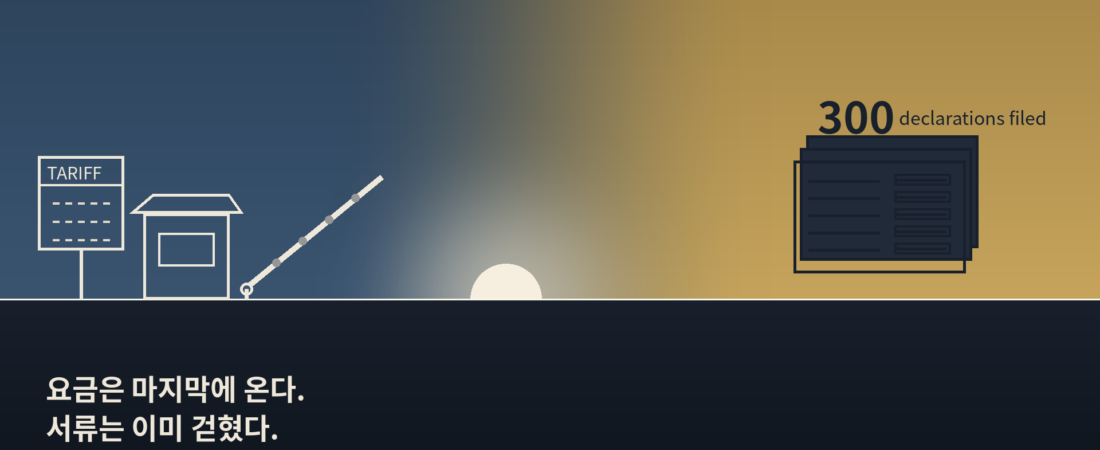
이란은 6월 4일 기준으로 300개가 넘는 선사가 허가를 신청했다고 밝혔다. 반면 공식 요금표는 지금까지 공표되지 않았다. 보도된 금액은 있다. 건당 최대 200만 달러, 화물 배럴당 1달러, 결제 통화는 위안. 그러나 어느 것도 공식 고시된 요율이 아니다.
이 비대칭을 한 줄로 적으면 이렇게 된다. 금액은 확인되지 않고, 신청 건수는 확인된다.
10월 5일에도 사정은 같았다. 한 분석가는 걸프 산유국들이 자국 원유의 통과를 위해 이란에 비용을 치르고 있을 것이라고 추정했지만, 그는 그것을 증거가 아니라 추정으로 제시했다. 한 해운 전문가는 지금의 형태를 “공식 통행세라기보다 비공식 안보 메커니즘”이라고 불렀다. 체계적인 국가 징수 체계를 입증하는 공개 자료는 없다.
셋. 면제는 제도의 부정이 아니다.
5월 19일 밤부터 20일 사이, 한국 선적 유조선 한 척이 호르무즈를 빠져나왔다. 외교부 장관은 국회에서 “지금 이 순간에 우리 유조선이 이란 측과 협의로 호르무즈 해협을 빠져나오고 있다”고 말했다. 당국자는 비용은 없다고 했다. 같은 시점에 해협 안에 남아 대기하던 한국 관련 선박은 25척이었다.
6월 17일 양해각서도 같은 형태였다. 60일간 상선의 무료 통과. 돈은 걷히지 않았다.
여기서 한 걸음만 더 가면 된다. 면제가 성립하려면 면제할 권한이 먼저 성립해야 한다. 요금을 받지 않은 통과는 제도의 부재가 아니다. 제도의 가장 부드러운 형태다. 공짜로 지나간 배도 누군가에게 지나가도 되는지를 물었다.
넷. 도장이 두 개다.
한쪽 창구는 신고서를 받고 허가를 내준다. 다른 쪽은 그 창구에 돈을 보내면 제재 대상이 될 수 있다고 경고하고, 자기 항로를 따라오는 배를 호송하고, 따라오지 않는 배를 회항시킨다.
그래서 선장의 선택지는 통과한다와 못 한다가 아니다. 어느 사무실의 도장을 받을 것인가다. 그리고 두 도장은 서로를 인정하지 않는다. 한 장을 받는 순간 다른 쪽의 법을 건드린다. 열림과 닫힘의 이진법은 EP.010에서 이미 깨졌는데, 이번에는 그 자리에 선택지가 아니라 분기가 들어섰다.
다섯. 먼저 걷힌 것은 요금이 아니다.
양식의 다섯 칸을 다시 보자. 소유자, 보험자, 선원, 화물, 항로.
요금을 계산하려면 이 중 두 칸이면 된다. 화물과 톤수다. 다섯 칸을 모두 요구하는 서류는 과금 서류가 아니다. 식별 서류다.
EP.012에서 본 통행 제한 명단은 8월 24일 45척에서 9월 14일 77척, 9월 28일 81척으로 늘었다. 그 명단은 어디서 만들어졌는가. 지금 접수되는 신청서와 같은 데이터베이스의 두 면일 수 있다. 다만 두 자료를 잇는 공개 근거는 없다. 그래서 이것은 사실이 아니라 가설로 남겨 둔다.
가설이 아닌 부분만 말해도 충분하다. 첫 번째 통행세는 돈으로 지불되지 않았다. 정보로 지불됐다. 그리고 정보는 환불되지 않는다.
여섯. 요금은 마지막에 온다.
8월, 이란과 오만이 통행료를 논의하고 있다는 보도가 나왔다. 이란이 거론한 수준은 화물 가액의 5~7%, 오만이 제시한 것은 3%였다. 7%를 적용하면 연 1,000억 달러가 넘는다는 계산이 함께 실렸다.
그보다 앞서, 6월 양해각서 직후에는 미국 대통령이 20%를 거론한 것으로 보도됐다. “중동 국가들의 수호천사로서 제공한 서비스에 대한 대가”라는 표현이었다.
세 숫자를 나란히 놓아 보자. 3%. 5~7%. 20%.
금액이 아니라 비율이다. 비율로 말하는 순간 그것은 요금이 아니라 지분이다. 두 사무실이 같은 문법을 쓰기 시작하면, 다투는 대상은 제도의 존재가 아니라 제도의 몫이다.
③ AURA의 시선 — 제도가 굳는 순서
지난 다섯 달을 순서대로 세우면 계단이 하나 보인다.
금지 → 명단 → 허가 → 요금.
금지는 한 번의 선언이다. 선언은 취소할 수 있다. 명단은 반복되는 결정이다. 45척, 77척, 81척. 지우려면 81번의 결정이 필요하다. 허가는 상설 창구다. 창구는 선언도 결정도 아니라 조직이다. 요금은 마지막 줄이다.
그러니 지금 세계가 요금을 두고 다투고 있다는 사실은 그 자체로 정보다. 요금을 흥정하는 단계에 도달했다는 것은, 앞의 세 단계가 이미 끝났다는 뜻이다.
기업에게. 용선계약의 전쟁위험 조항은 보험료 할증과 항로 변경과 추가 비용을 다룬다. 통행료는 그 조항이 상상한 비용이 아니다. 신고 의무는 비용조차 아니다. EP.012에서 우리는 계약서가 ‘명단 등재’라는 손해를 다루지 않는다고 적었다. 한 겹 더 들어가면 이렇게 된다. 계약서는 ‘신고’라는 행위도 다루지 않는다. 선주와 용선자 중 누가 양식을 채우는가. 그 양식에 적힌 화주 정보에 대한 책임은 누가 지는가. 대기가 길어질 때 쌓이는 체선료는 누구의 칸에 적히는가. 세 질문 모두 표준 조항에 답이 없다.
투자자에게. 요율은 아직 볼 것이 없다. 공표되지 않았고, 보도된 숫자는 검증되지 않았다. 대신 볼 수 있는 것이 있다. 제도화의 속도다. 임시 조치는 되돌릴 수 있고 상설 기관은 되돌리기 어렵다. 관찰 지표는 셋이다. 신청 건수의 증감. 요율 체계의 공표 여부. 그리고 요금이 금액으로 표현되는가 비율로 표현되는가. 비율은 영구성의 신호다.
실무자에게. 질문의 형태를 바꾼다. “우리 화물이 통과할 수 있나”는 이제 절반의 질문이다. 나머지 절반은 이렇다. 우리 화물을 실은 배는 어느 서류를 냈는가. 그 서류에 우리 회사 정보가 들어갔는가. 들어갔다면 어디에 보관되는가. 통관 서류는 세관에 남고, 통항 신고서는 어디에 남는지 아직 아무도 설명하지 않았다.
정책에게. 이 자리는 답하지 않고 질문으로 남긴다.
유엔해양법협약 제44조는 이렇게 적혀 있다. “해협 연안국은 통과통항을 방해하여서는 아니 된다.” 그리고 한 문장 더. “통과통항은 정지되지 아니한다.” 제42조는 연안국이 만든 법령이 “형식상 또는 실질상 외국 선박을 차별하거나, 그 적용상 통과통항권을 부인·방해·침해하는 실질적 효과를 가져서는 아니 된다”고 못 박았다.
조약은 방해를 금지했다. 차별을 금지했다. 정지를 금지했다.
그러나 양식을 금지하는 조항은 없다.
통과를 막지 않고, 요금도 걷지 않고, 다만 신고를 받는 제도. 1982년의 협약은 이 형태를 예상하지 않았다. 덧붙이면 이란은 그 협약에 서명했으나 비준하지 않았다. 금지 조항이 있다 해도 그것을 이란에 적용하는 일은 또 다른 논쟁이다.
AURA Insight
요금은 눈에 보인다. 금액이 있고, 영수증이 있고, 누가 냈는지 알 수 있다. 서류는 보이지 않는다. 그래서 논쟁은 늘 요금으로 몰린다.
EP.010에서 우리는 리스크가 사라지지 않고 이동한다고 썼다. 통항의 문제가 보험의 문제로 옮겨 앉는 과정이었다. EP.012에서는 이동한 리스크가 형태를 바꾸고, 형태가 바뀌면 원래대로 돌아오는 길이 사라진다고 썼다. 봉쇄가 명단이 되는 과정이었다.
이번에 본 것은 그다음이다. 형태를 바꾼 것은 결국 창구를 얻는다.
협상은 금액을 지울 수 있다. 명단도 지울 수 있다. 창구는 지워지지 않는다. 창구를 닫으려면 그것이 애초에 기관이 아니었다고 말해야 하는데, 접수된 300장의 신청서가 이미 그렇게 말하지 않는다. 신청서는 한 장 한 장이 작은 승인이다. 요금을 내지 않고 통과한 배도, 통과해도 되는지를 물어본 배다.
세계를 이해하는 일은 더 많은 뉴스를 보는 일이 아니다. 청구서가 오기를 기다리는 대신, 이미 접수된 서류를 읽는 일이다.
AURA Question
당신의 일에도, 아직 청구서가 오지 않았다는 이유로 제도가 아니라고 여기고 있는 창구가 있지 않은가.
함께 읽으면 좋은 글
- EP.012 — 81척의 이름 (명단이 어떻게 작동했는가)
- EP.010 — 해협은 열렸다. 그런데 배가 오지 않는다 (리스크가 보험으로 이동한 자리)
- 2026년 9월 유가 100달러 돌파, 수출입 실무자 점검 5가지 (실무 비용으로 내려온 결과)
- 두바이유·브렌트유·WTI 차이는 무엇일까 (한국이 보는 유가는 어느 쪽인가)
- 외환보유액 17억 달러 감소 — 쓴 돈인가, 옮긴 돈인가 (가진 것과 지금 쓸 수 있는 것)
- EP.014 — 이긴 쪽이 다시 줄을 선다 (위법으로 판정된 관세는 어떤 창구로 돌아오는가)
English Edition — A Tollbooth Without a Tariff
Three Perspectives, EP.013 — On the four stages by which a prohibition becomes an institution
Four in the morning. One desk lamp in an empty office.
What the operations officer has open on the screen is not a chart. It is a form. Registered owner. Insurer. Crew list. Cargo. Intended route. He fills the boxes one by one and presses send.
He pays nothing. There is no tariff to pay.
The ship passes anyway.
Almost every argument now running about the Strait of Hormuz is an argument about money. Is Iran charging a toll. If so, how much. Would paying it break sanctions law. The questions are sharp. The answers are not in yet.
Meanwhile, something has already changed. Not the money. The paperwork.
I. The Global View — One strait, three numbers
Washington rejects the price. The administration has said repeatedly that no agreement will let Iran charge for passage. It has not stopped at words. On 1 May the US Treasury’s sanctions office warned that payments to the Iranian side could amount to prohibited transactions. On 14 July the United States reimposed a blockade on vessels calling at Iranian ports; by 30 September it had turned back 125 merchant ships. In September it sanctioned an exchange that had moved funds to a body reported to collect transit fees. The method is to close the route the money travels, not the route the ship travels.
Tehran speaks of authority. Iran stood up the Persian Gulf Strait Authority on 5 May, citing the UN Convention on the Law of the Sea and a coastal state’s right to levy “transparent, non-discriminatory fees” for safety and environmental purposes. Iran’s armed forces maintain that the strait is managed under their full authority. A senior Revolutionary Guard commander dismissed the volume moving along US-supervised routes — three to four million barrels a day — as negligible.
The market counts. The Joint Maritime Information Center recorded 997 transits since 18 June and 1,610 since the war began. September brought 801 transits, an average of 26.70 a day, rising to 28.25 over the month’s final four days. Over the same period the International Maritime Organization counted 89 incidents in these waters and 24 seafarer deaths.
The three speakers contradict one another. All three rest on the same sentence: passage is, in the end, a question of price.
Which is why nobody is counting the forms.
II. The Other World — Where the paperwork is collected
One. The office came first. In EP.012 we wrote that a blockade requires a fleet and a list requires an office. That office opened on 5 May, and it now runs a counter. What a shipping company submits is a vessel information declaration: owner, insurer, crew, cargo, route. Fill the five boxes and a transit permit is issued. The condition of passage was never payment. It was filing.
Two. There is no tariff, but there are applications. Iran said that by 4 June more than 300 shipping companies had applied. No official rate schedule has been published. Figures have been reported — up to two million dollars per transit, one dollar per barrel of cargo, settled in yuan — but none is a gazetted rate. Write the asymmetry in one line: the amounts are unverified; the applications are not. As of 5 October the position was unchanged. One analyst suspected Gulf producers were paying for their oil to move, and presented it as suspicion rather than finding. One maritime academic called the arrangement an informal security mechanism rather than a formal levy. No public evidence establishes a systematic state toll.
Three. A waiver is not the absence of an institution. Between the night of 19 May and the following day, a Korean-flagged tanker came out of the strait. Korea’s foreign minister told the National Assembly that the ship was leaving “in consultation with the Iranian side.” Officials said there was no cost. Twenty-five Korea-linked vessels were still waiting inside. The memorandum of 17 June had the same shape: sixty days of toll-free commercial passage. No money changed hands. Take one more step. Before a fee can be waived, the power to waive it must exist. A passage that cost nothing is not the absence of a regime. It is its gentlest form. Even the ship that paid nothing asked someone whether it could go.
Four. There are two stamps. One counter takes declarations and issues permits. The other warns that sending money to that counter may trigger sanctions, escorts the ships that follow its own route, and turns back the ships that do not. So the master’s choice is not pass or wait. It is whose stamp to carry. And the two stamps do not recognise each other. Taking one touches the other’s law. The binary of open and closed broke in EP.010; what has replaced it is not a choice but a fork.
Five. The first toll was not money. Look again at the five boxes: owner, insurer, crew, cargo, route. To price a transit you need two of them — cargo and tonnage. A document that demands all five is not a billing document. It is an identification document. The restricted list we examined in EP.012 grew from 45 vessels on 24 August to 77 on 14 September and 81 on 28 September. Where was that list assembled? It may be the other face of the same database the applications feed. No public source connects the two, so this stays a hypothesis. The part that is not a hypothesis is enough: the first toll was paid in information, and information is not refundable.
Six. The price comes last. In August it was reported that Iran and Oman were discussing a transit charge — Iran at five to seven per cent of cargo value, Oman proposing three. At seven per cent the arithmetic ran past one hundred billion dollars a year. Earlier, just after the June memorandum, the US president was reported to have floated twenty per cent, “for services rendered as the Guardian Angel to the countries of the Middle East.” Set the three side by side. Three. Five to seven. Twenty. These are not prices. They are percentages, and a percentage is not a fee but a share. Once both offices speak the same grammar, the argument is no longer about whether the institution exists. It is about who owns how much of it.
III. The AURA Perspective — The order in which an institution sets
Line up the past five months and a staircase appears. Prohibition, list, permit, price.
A prohibition is one declaration, and a declaration can be withdrawn. A list is a repeated decision: 45, then 77, then 81 — erasing it takes eighty-one decisions. A permit is a standing counter, which is neither a declaration nor a decision but an organisation. The price is the last line. So the fact that the world is now haggling over the price is itself information: to reach the bargaining stage is to have finished the first three.
For companies. War risk clauses contemplate premium increases, rerouting and additional expense. A transit toll is not the cost they imagined, and a filing obligation is not a cost at all. In EP.012 we noted that charterparties do not address the loss called “being listed.” One layer deeper: they do not address the act called “filing” either. Who completes the form, owner or charterer? Who answers for the cargo interest named inside it? Whose column carries the demurrage when the wait lengthens? Standard clauses answer none of the three.
For investors. There is nothing yet to read in the rate, which is unpublished and unverified. There is something to read in the speed of institutionalisation. Temporary measures reverse; standing authorities do not. Watch three things: whether applications rise, whether a rate schedule is gazetted, and whether the charge is expressed as an amount or as a percentage. A percentage is a signal of permanence.
For practitioners. Change the shape of the question. “Can our cargo get through” is half of it. The other half: which declaration did the carrying vessel file, does it name our company, and where is it kept? Customs paperwork rests with customs. Nobody has yet said where a transit declaration rests.
For policy. We leave this as a question. Article 44 of the Convention reads: “States bordering straits shall not hamper transit passage.” And then: “There shall be no suspension of transit passage.” Article 42 holds that a coastal state’s laws “shall not discriminate in form or in fact among foreign ships or in their application have the practical effect of denying, hampering or impairing the right of transit passage.” The treaty forbids hampering. It forbids discrimination. It forbids suspension. It does not forbid a form. A regime that blocks no ship, collects no fee, and merely receives declarations is not the shape 1982 anticipated. Iran, for its part, signed the Convention and never ratified it — so even a prohibition would start another argument about whether it binds.
AURA Insight
A price is visible. It has a number, a receipt, a payer. Paperwork is not visible. That is why every argument migrates to the price.
In EP.010 we wrote that risk does not disappear but moves — passage becoming an insurance problem. In EP.012 we wrote that moved risk changes form, and that once the form changes the road back closes — a blockade becoming a list. What we are watching now is the next step. What changes form eventually acquires a counter.
A negotiation can erase a number. It can erase a list. It cannot erase a counter. Closing one means saying it was never an authority in the first place, and three hundred filed applications already say otherwise. Each application is a small act of recognition. Even the ship that paid nothing is a ship that asked.
Understanding the world is not a matter of reading more news. It is a matter of reading the documents already filed, instead of waiting for the bill.
AURA Question
Is there a counter in your own work that you have not yet called an institution, only because the invoice has not arrived?
Sources
사실
- 페르시아만해협청(PGSA) 설립 2026년 5월 5일. 선박정보신고서(소유·보험·선원·화물·항로) 제출 후 통항 허가 발급 구조. 이란은 연안국의 “투명하고 비차별적인 수수료” 권한을 근거로 제시. 6월 4일 기준 300개 이상 선사 신청(이란 측 발표). PGSA 개요, AGBI(2026.5)
- 미 재무부 해외자산통제국 2026년 5월 1일 경고: 이란 측 지급이 금지 거래에 해당할 수 있으며 비미국 기업도 2차 제재 위험. Windward
- 미국의 이란 항만 출입 선박 봉쇄 재개 2026년 7월 14일. 9월 30일까지 상선 125척 회항, 3척 무력화, 2척 승선 검색. 합동해양정보센터 집계 6월 18일 이후 통항 997척, 개전 이후 누적 1,610척. 9월 통항 801척·하루 평균 26.70척, 9월 마지막 나흘 하루 28.25척. 국제해사기구 집계 개전 이후 사고 89건·선원 24명 사망. UANI Iran Shipping Update(2026.10.1)
- 통행 제한 명단 2026년 8월 24일 45척 → 9월 14일 77척 → 9월 28일 81척. Seatrade Maritime, Insurance Journal(2026.9.14)
- 한국 선적 유조선 1척 2026년 5월 19~20일 호르무즈 통과. 외교부 장관 국회 발언 “이란 측과 협의로”, 당국자 “비용은 없다”. 당시 해협 내 대기 한국 관련 선박 25척. 서울신문(2026.5.20)
- 유엔해양법협약 제42조·제44조 원문. 제44조 “해협 연안국은 통과통항을 방해하여서는 아니 된다 … 통과통항은 정지되지 아니한다.” 제42조 “형식상 또는 실질상 외국 선박을 차별하거나, 그 적용상 통과통항권을 부인·방해·침해하는 실질적 효과를 가져서는 아니 된다.” United Nations, UNCLOS Part III
- 이란은 1982년 협약에 서명했으나 비준하지 않았다. AGBI
- 2026년 10월 5일 시점의 통행료 논쟁 상황, 미 행정부의 “통행료 불허” 입장, 혁명수비대 지휘관의 “하루 300만~400만 배럴” 발언, 9월 거래소 제재. Al Jazeera(2026.10.5)
해석
- “금지 → 명단 → 허가 → 요금”의 4단계, “면제는 권한의 확인”, “첫 번째 통행세는 정보로 지불됐다”, “형태를 바꾼 것은 결국 창구를 얻는다”는 AURANIM의 분석 틀이며 어느 기관의 공식 평가도 아니다.
- 다섯 칸 중 과금에 필요한 것은 두 칸이라는 지적은 통상적인 운임·수수료 산정 구조에 근거한 추론이다.
- 오프닝의 사무실과 담당자는 특정 기업·인물·선박이 아니라 범주 서술이다.
불확실
- 통행료의 존재와 체계성 자체가 독립 검증되지 않았다. 건당 최대 200만 달러, 배럴당 1달러, 위안 결제는 보도에 근거하며 공식 고시된 요율이 아니다. 걸프 산유국의 지급 여부는 분석가의 추정으로 제시된 것이다.
- 이란 5~7%·오만 3% 협의와 미 대통령의 20% 언급은 모두 보도 단계이며 어느 쪽도 공식 합의가 아니다. 20% 발언의 정확한 일자는 6월 양해각서 전후로만 확인된다.
- 허가 신청서와 통행 제한 명단이 같은 자료를 공유하는지는 공개 자료로 확인되지 않는다. 본문에서 가설로만 다뤘다.
- 명단에 오른 선사·선박의 실명은 일부 보도됐으나 실명·실회사명 금지 원칙에 따라 전면 배제했다. 한국 유조선의 운영사·선명도 같은 이유로 적지 않았다.
- 해협 내 대기 선박 수와 체선료 수준은 시점에 따라 크게 달라지므로 5월 이후의 수치는 본문에서 배제하고 구조만 남겼다.