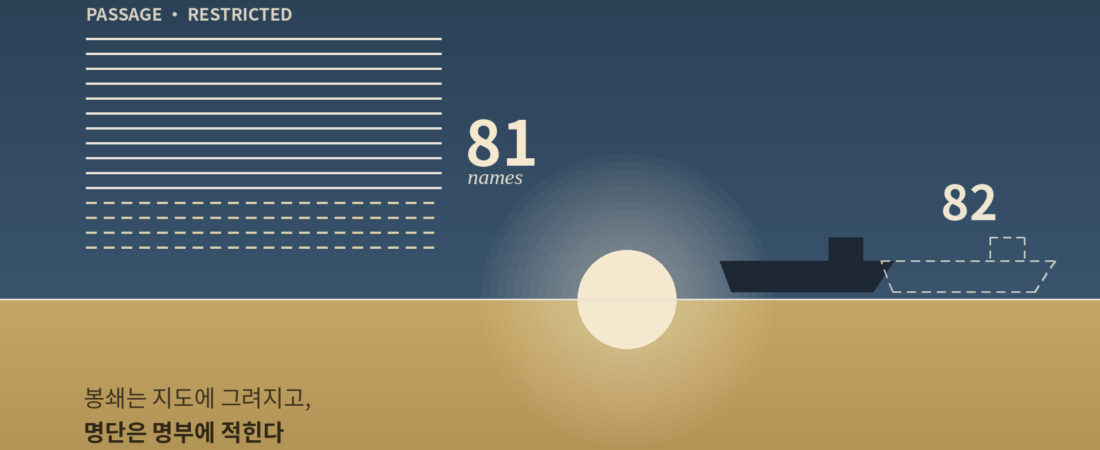
새벽, 호르무즈 입구에서 배 한 척이 서 있다. 날씨는 좋다. 기관에도 문제가 없다. 선장이 기다리는 것은 조류가 아니라 회신이다.
그는 화면에 뜬 목록을 다시 내린다. 배 이름이 알파벳 순으로 적혀 있다. 자기 배는 없다. 그런데도 그는 엔진을 올리지 않는다.
2주 전 그 목록은 77줄이었다. 어제는 81줄이 됐다. 없다는 것은, 아직 없다는 뜻이다.
① 세계의 시선 — 모두가 총량을 센다
같은 주, 같은 해협을 놓고 세 개의 숫자가 발표됐다.
워싱턴은 척수를 말했다. 9월 29일 미국 대통령은 하루 29척이 정상적으로 해협을 통과했고 대규모 원유가 걸프 해역을 빠져나가고 있다고 밝혔다. 미 중부사령부는 한 걸음 더 나아갔다. 이란 해군 전력이 이미 격침됐으므로 이란에는 해협을 통제할 실질적 능력이 없다는 평가였다. 해협은 열려 있다. 숫자가 그것을 증명한다.
테헤란은 다른 숫자를 말했다. 국영 통신은 선박 7척을 타격하고 12척을 공격했다고 주장했다. 이쪽의 숫자는 통행량이 아니라 능력의 증명이다. 우리는 아직 손을 댈 수 있다는 문장이 숫자의 형태로 나왔다.
시장은 가격을 말했다. 9월 셋째 주, 두바이유는 배럴당 115달러였다. 브렌트유는 102달러, 서부텍사스유는 98달러였다. 교과서가 가르치는 서열이 뒤집힌 상태다. 시장은 해협을 열림과 닫힘으로 말하지 않는다. 프리미엄의 크기로 말한다.
세 화자는 서로를 반박하고 있는 것처럼 보인다. 그런데 자세히 보면 이들은 같은 방식으로 말하고 있다. 모두 총량을 센다. 통과한 배가 몇 척인지, 맞은 배가 몇 척인지, 배럴당 몇 달러인지. 전부 전체에 대한 하나의 숫자다.
공유된 전제는 이것이다. 해협의 상태는 하나의 수치로 표현될 수 있다. 그 전제를 받아들이면, 세 숫자 중 어느 것이 맞는지를 다투게 된다.
그러나 그 논쟁에서는 아무도 세지 않는 것이 하나 있다. 이름이다.
② 또 하나의 세계 — 명부가 열리는 자리
장면 하나. 함대가 아니라 사무실
이란은 올해 페르시아만해협청이라는 기관을 새로 만들었다. 이 기관이 하는 일은 배를 막는 것이 아니다. 목록을 만드는 것이다.
8월 24일 45척이었던 통행 제한 명단은 9월 14일 77척이 됐다. 9월 28일에는 81척으로 늘었다. 한 달 남짓에 거의 두 배다. 기관은 명단 선박이 벌금, 억류, 몰수 조치를 받을 수 있다고 경고했다.
미 중부사령부의 평가가 맞을 수도 있다. 이란에 해협을 물리적으로 통제할 능력이 남아 있지 않을 수도 있다. 문제는 그 평가가 이 기관의 작동과 무관하다는 점이다. 봉쇄에는 함대가 필요하고, 명단에는 사무실이 필요하다. 비용이 다르다.
장면 둘. 숫자의 성질이 다르다
45, 77, 81. 이 숫자는 통항량과 같은 종류가 아니다.
통항량은 오르고 내린다. 좋은 날에는 늘고 나쁜 날에는 줄고, 다음 주에 회복될 수 있다. 명부는 그렇지 않다. 명부는 쌓인다. 한 줄이 지워지려면 누군가가 그 줄을 지우는 결정을 해야 한다. 아무도 결정하지 않으면 그 줄은 그대로 있다.
같은 사건을 두 가지 단위로 셀 수 있다. 하나는 되돌아오고, 하나는 되돌아오지 않는다.
장면 셋. 명단의 진짜 수신자
이 명단에서 가장 중요한 문장은 선박을 향한 것이 아니다.
기관은 보험사와 선주상호보험조합, 그리고 선급협회에 명단 선박에 대한 서비스 제공을 자제하라고 요구했다. 배를 세우는 대신 배의 서류를 세우는 방식이다.
이 경로를 이해하려면 배가 무엇으로 움직이는지를 알아야 한다. 선급 증서가 없으면 보험에 들 수 없다. 보험 증서가 없으면 대부분의 항만에 들어갈 수 없고, 용선 계약의 조건도 충족하지 못한다. 엔진은 멀쩡한데 서류가 멈춘 배는 움직일 수 없다.
EP.010에서 우리는 통항의 언어와 보험의 언어가 다르다고 썼다. 그때 보험은 리스크를 재는 자였다. 이번에는 다르다. 보험이 통로가 됐다. 재는 도구를 쥐면, 그것을 잠글 수도 있다.
장면 넷. 계약서의 한 줄
기관이 내놓은 명분을 그대로 읽어 보면 이렇다. 일부 용선사가 선박에 불법 항로 이용을 강요하고 있다는 것이다.
이 문장은 겨냥하는 대상을 바꾼다. 배가 아니라 배를 빌린 쪽이다. 해상 운송에서 항로를 지시하는 권한은 대개 용선 계약서 안에 있다. 선주는 배를 대고, 용선사는 항로를 정한다. 전쟁위험 조항은 위험 구역에서 회항할 권리와 추가 보험료의 부담 주체를 정해 둔다.
그런데 표준 조항이 다루지 않는 손해가 하나 있다. 명단에 오르는 것 자체가 손해일 때다. 배가 다치지 않았고 화물도 무사한데, 그 배의 미래 수익이 줄어든다. 이 손해는 누구의 것인가. 계약서에 그 줄이 없으면, 답은 분쟁으로만 나온다.
장면 다섯. 82번째
9월 14일 주말, 해협을 통과한 상선은 한 자릿수로 떨어졌다. 그 직전 열흘 평균은 하루 14척이었다.
이 급감을 만든 것은 명단에 오른 77척이 아니다. 그 77척은 애초에 가려던 배들이었고, 숫자로는 소수다. 통항량을 떨어뜨린 것은 명단에 없는 배들이다.
새벽의 선장이 기다리던 회신이 그것이다. 그의 배는 목록에 없다. 그래도 그는 기다린다. 목록이 어제 네 줄 늘었기 때문이다. 명부가 늘어나는 속도를 보면, 없다는 사실은 안심이 아니라 확률이 된다.
명단은 81척을 세우기 위해 만들어지지 않았다. 82번째가 되고 싶지 않은 모든 배를 움직이기 위해 만들어졌다. 그리고 그 효과에는 요금이 붙지 않는다.
장면 여섯. 파이프와 유종
지리는 명부를 피할 수 있다. 사우디아라비아가 서부 송유관을 재개한 것이 그 예다. 해협을 지나지 않는 원유에는 명단이 붙지 않는다.
그런데 지리의 우회에는 값이 있다. 한국이 실제로 사는 유종의 가격에 그것이 남는다. 9월 셋째 주 두바이유가 브렌트유보다 13달러 비쌌다는 사실은 품질의 차이가 아니다. 산지의 차이다. 한국의 원유 수입에서 중동산 비중은 지난 5월부터 7월까지 48.5%였다. 1년 전 같은 기간에는 69.1%였다.
비중은 줄었다. 그래도 절반에 가깝다. 명부는 계약서에만 적히는 것이 아니다. 유종 코드에도 적힌다.
③ AURA의 시선
기업에게. 점검할 문서는 항로도가 아니라 용선 계약서다. 항로 지시권이 어느 쪽에 있는지, 전쟁위험 조항이 추가 보험료까지만 다루는지 아니면 통행 제한으로 인한 손실까지 다루는지, 명단 등재가 계약 위반에 해당하는지. 지금은 조항이 없다는 사실 자체가 리스크다.
투자자에게. 유가를 한 줄로 보는 습관이 이번 국면에서는 오독을 만든다. 볼 것은 유종 간 스프레드이고, 그 스프레드가 정상 서열로 돌아오는지다. 그리고 보험과 재보험의 갱신 주기다. 뉴스는 매일 오지만 요율은 갱신일에만 바뀐다. 좋은 소식이 값에 반영되는 데는 시차가 있다.
물류 실무자에게. 질문의 형태를 바꿀 때다. 해협이 열렸는지를 묻는 대신, 우리 선박과 용선사와 선급이 어느 목록에 있는지를 묻는 쪽이 정확하다. 전자는 뉴스로 알 수 있고 후자는 조회로만 알 수 있다.
정책에게 — 답하지 않고 질문으로 남긴다. 9월 28일 이란 외무장관은 중재국을 통한 협상 가능성을 언급했다. 그 전에 이란은 해상봉쇄 해제와 동결 자금 반환이 이뤄지면 7일 안에 해협을 개방할 수 있다고 제안했다. 미국 대통령은 어떤 제안도 하지 않았다고 부인했고, 이란 측은 핵 문제에는 어떠한 유연성도 없으며 지금은 오직 호르무즈 문제뿐이라고 했다.
협상 목록에 올라 있는 단어들을 보자. 봉쇄, 자금, 핵. 명단은 없다. 봉쇄를 푸는 협상과 명부를 지우는 협상은 같은 협상이 아니다. 전자는 하나의 결정으로 끝나고, 후자는 81번의 결정을 요구한다.
AURA Insight
EP.010에서 우리는 리스크가 사라지지 않고 이동한다고 썼다. EP.011에서는 좋은 것도 이동하며, 이동하는 동안 부호를 바꾼다고 썼다. 두 편이 남긴 질문은 하나였다. 이동을 멈추거나 되돌릴 수 있는 지점이 있는가.
81척의 명부가 그 질문에 답하고 있다. 이동한 리스크는 형태를 바꾼다. 그리고 형태가 바뀌면 되돌아오는 길이 사라진다.
봉쇄는 지도에 그려지고, 명단은 명부에 적힌다. 지도는 하루아침에 지울 수 있다. 협정문에 서명하고 함대를 물리면 지도는 원래대로 돌아온다. 명부는 그렇게 되지 않는다. 한 줄씩 지워야 하고, 지워진 뒤에도 한 번 적혔다는 사실은 남는다. 요율을 산정하는 사람의 표에 남고, 다음 용선 계약의 조건에 남는다.
그리고 이 방식의 가장 불편한 성질은 힘이 필요하지 않다는 것이다. 미 중부사령부의 평가가 맞다고 해도, 명부는 계속 작동한다. 통제력 대신 불확실성으로 작동하기 때문이다. 능력을 증명할 필요 없이 목록 한 줄을 늘리면 된다. 싸고, 조용하고, 되돌리기 어렵다. 이런 도구는 한번 발명되면 사라지지 않는다.
세계를 이해하는 일은 더 많은 뉴스를 읽는 것이 아니다. 지금 필요한 것은 습관 하나를 버리는 일이다. 한 해협의 상태를 총량으로 묻는 습관이다.
AURA Question
당신의 일에도, 총량으로 발표되지만 실제로는 명부로 작동하는 것이 있지 않은가.
함께 읽으면 좋은 글
- EP.010 — 해협은 열렸다. 그런데 배가 오지 않는다
- EP.011 — 역대 최대의 반대쪽
- 두바이유·브렌트유·WTI 차이는 무엇일까
- 호르무즈에 이어 홍해까지 — 수출입 실무자가 점검할 5가지
- 인코텀즈 2020 총정리 — FOB와 CIF 차이
English Edition — Eighty-One Names
Three Perspectives, EP.012 — On the difference between a blockade and a list
Before dawn, a ship sits at the mouth of the Strait of Hormuz. The weather is fine. The engines are sound. What the master is waiting for is not the tide. It is a reply.
He scrolls the list again. Ship names, alphabetical. His is not there. He does not increase revolutions.
Two weeks ago the list ran to seventy-seven lines. Yesterday it reached eighty-one. Not being on it means not yet.
I. The Global Perspective — Everyone Counts Totals
In a single week, three numbers were published about the same strait.
Washington counted hulls. On 29 September the US president said twenty-nine vessels had transited normally in a day and that large volumes of crude were leaving the Gulf. Central Command went further: Iranian naval capability had been destroyed, so Tehran had no real ability to control the strait. The strait is open, and the number proves it.
Tehran counted differently. State media claimed seven vessels struck and twelve attacked. That number is not about traffic. It is a proof of capability, rendered as arithmetic.
The market counted in dollars. In the third week of September, Dubai crude stood at $115 a barrel, Brent at $102, West Texas Intermediate at $98 — the textbook ranking inverted. Markets do not describe a strait as open or closed. They describe it as a premium.
The three speakers appear to contradict one another. Look again and they are speaking the same way. All of them count totals. Hulls through, hulls hit, dollars per barrel. One number for the whole.
The shared assumption is that the condition of a strait can be expressed as a single figure. Accept it, and the argument becomes which figure is correct.
But there is one thing none of them counts. Names.
II. The Other World — Where the Register Opens
An office, not a fleet. Iran created a new body this year, a Persian Gulf strait authority. Its work is not to stop ships. It is to keep a list. The restricted-passage register held forty-five vessels on 24 August, seventy-seven on 14 September, eighty-one on 28 September — nearly doubled in a month. Listed ships, the authority warned, may face fines, detention or confiscation.
Central Command may be right that Tehran can no longer physically close the strait. That assessment is simply irrelevant to how this instrument works. A blockade requires a fleet. A list requires an office. The costs are not comparable.
A different kind of number. Forty-five, seventy-seven, eighty-one. These are not the same species as traffic counts. Traffic rises and falls and recovers. A register accumulates. A line disappears only if someone decides to remove it. Absent that decision, it stays. The same event can be counted in two units — one of which comes back, and one of which does not.
The real addressee. The most consequential sentence in the register is not aimed at ships. The authority asked insurers, protection and indemnity clubs and classification societies to withhold services from listed vessels. Rather than stopping the hull, it stops the paper. Without class, no cover. Without cover, most ports are closed and most charter terms unmet. A ship with sound engines and suspended documents does not sail.
In EP.010 we wrote that the language of transit and the language of insurance differ. There, insurance was the instrument that measured risk. Here it is something else. Insurance has become the channel. Whoever holds the measuring instrument can also close the valve.
One line in a charter party. Read the authority’s stated grievance plainly: certain charterers, it says, are compelling vessels onto unlawful routes. That sentence moves the target from the ship to the party that hired it. In shipping, routing authority usually sits in the charter party. Owners provide the hull; charterers direct the voyage. War risk clauses allocate the right to deviate and the burden of additional premium.
But standard clauses do not contemplate one loss: the loss of being listed. The hull is undamaged, the cargo intact, and the vessel’s future earnings have fallen. Whose loss is that? Where the contract is silent, the answer arrives only as a dispute.
The eighty-second. Over the weekend of 14 September, merchant transits fell to single digits, against a ten-day average of fourteen a day. The seventy-seven listed vessels did not cause that. They were a small number, and they were going anyway. What emptied the strait were the ships not on the list.
That is the reply the master was waiting for. His vessel is absent from the register. He waits because the register grew by four lines yesterday. Watch a list grow and absence stops being reassurance and becomes a probability.
The list was never built to halt eighty-one ships. It was built to move every ship that does not wish to be the eighty-second. And that effect is not invoiced.
Pipe and grade. Geography can route around a register — Saudi Arabia’s western pipeline is the example; crude that never enters the strait carries no listing. But detours have a price, and it settles in the grade a country actually buys. Dubai trading thirteen dollars above Brent is not a statement about quality. It is a statement about origin. Middle Eastern crude was 48.5 per cent of Korea’s imports from May to July, down from 69.1 per cent a year earlier. Reduced, and still near half. Registers are written into grade codes as well as contracts.
III. The AURA Perspective
For companies. The document to review is not the routing chart but the charter party. Who holds routing authority; whether the war risk clause reaches only additional premium or also losses from restricted passage; whether listing constitutes breach. The absence of such a clause is itself the exposure.
For investors. Reading oil as one line misleads in this regime. Read the spread between grades, and whether it returns to its normal order. Read renewal cycles in insurance and reinsurance. News arrives daily; rates change on renewal dates. Good news reaches price with a lag.
For logistics practitioners. Change the shape of the question. Instead of asking whether the strait is open, ask which register your vessel, your charterer and your class society appear on. The first is answered by news. The second only by a query.
For policy — left as a question. On 28 September Iran’s foreign minister pointed to mediated talks. Earlier, Tehran offered to reopen the strait within seven days if the naval blockade were lifted and frozen funds returned. The US president denied offering anything; Iran’s side said there was no flexibility on the nuclear file and that the matter now was Hormuz alone.
Look at the words on the negotiating list: blockade, funds, nuclear. The register is not there. Lifting a blockade and clearing a register are not the same negotiation. One ends with a single decision. The other requires eighty-one.
AURA Insight
EP.010 argued that risk does not vanish; it moves. EP.011 argued that good fortune also moves, and changes sign in transit. Both left one question: is there a point at which the movement stops, or reverses?
A register of eighty-one names answers it. Risk that moves also changes form, and once the form has changed, the road back closes.
A blockade is drawn on a map; a list is written in a register. Maps can be erased overnight — sign the agreement, withdraw the fleet, and the map returns. Registers do not work that way. They are cleared line by line, and even cleared lines leave a trace: in an underwriter’s table, in the next charter’s terms.
The most uncomfortable property of this instrument is that it requires no strength. Central Command’s assessment may be entirely correct, and the register will keep working, because it runs on uncertainty rather than control. No capability need be demonstrated; one line need only be added. It is cheap, quiet and hard to undo. Tools like that, once invented, do not disappear.
Understanding the world is not a matter of reading more news. What is needed now is to abandon one habit: asking after the condition of a strait as though it were a total.
AURA Question
In your own work, is there something announced as a total that actually operates as a register?
Sources
사실
· 2026년 9월 14일 보도: 이란이 신설한 페르시아만해협청(PGSA)의 호르무즈 통행 제한 명단이 8월 24일 45척에서 9월 14일 77척으로 확대. 명단 선박에 벌금·억류·몰수 가능성 경고. 보험사·선주상호보험조합·선급협회에 명단 선박 대상 서비스 제공 자제 요구.
· 같은 보도: 주말 사이 호르무즈 통과 상선 규모가 최근 10일 평균 하루 14척을 크게 밑도는 한 자릿수로 급감.
· 2026년 9월 29일 보도: 9월 28일 기준 명단 81척. PGSA는 일부 용선사가 선박에 불법 항로 이용을 강요하고 있다고 주장.
· 2026년 9월 29일 보도: 미국 대통령 “하루 29척이 정상적으로 해협을 통과했고 대규모 원유가 걸프 해역을 빠져나가고 있다”. 미 중부사령부는 이란 해군 전력 격침으로 이란에 실질 통제 능력이 없다고 평가. 이란 국영 통신은 선박 7척 타격·12척 공격 주장.
· 2026년 9월 28~29일 보도: 이란 외무장관, 중재국 카타르가 미국에 제안할 아이디어를 갖고 있다고 언급. 이란은 앞서 해상봉쇄 해제와 동결 자금 반환 시 7일 안에 호르무즈 개방 가능하다고 제안. 미국 측 제재 완화 의향 보도에 대해 미국 대통령은 “이란에 아무것도 제안한 적 없다”고 부인. 이란 외무장관은 핵 문제에 “어떠한 유연성도 없고 논의조차 이뤄진 적 없다”고 밝힘.
· 유종별 가격(2026년 9월 21일 기준): 두바이유 115달러, 브렌트유 102달러, 서부텍사스유 98달러.
· 한국 원유 수입 중동산 비중: 2026년 5~7월 48.5%(전년 동기 69.1%).
· 사우디아라비아 서부 송유관 재개로 일부 공급 충격 흡수.
해석
· “봉쇄에는 함대가 필요하고 명단에는 사무실이 필요하다”, “명부의 봉쇄”, “82번째의 값”, “보험이 통로가 됐다”는 개념화는 AURANIM 편집부의 해석입니다.
· 9월 14일 주말 통항 급감의 원인을 명단 미등재 선박의 자발적 대기로 설명한 것은 편집부의 추론입니다. 통항 감소의 선박별 사유는 공표되지 않습니다.
· 표준 용선 계약서의 전쟁위험 조항이 명단 등재로 인한 손실을 다루지 않는다는 지적은 일반적 계약 관행에 근거한 편집부 판단이며, 개별 계약의 내용은 계약마다 다릅니다.
· 오프닝의 선장과 브리지 장면은 특정 선박·인물이 아니라 범주로 쓴 서술입니다.
불확실
· 워싱턴이 제시한 하루 29척(9월 29일)과 한 자릿수 통항(9월 14일 주말)은 약 2주 간격의 수치입니다. 실제 회복인지, 집계 대상이 다른 것인지는 공표 자료로 구분되지 않습니다. 이 글은 어느 쪽도 사실로 단정하지 않았습니다.
· 현재 시점의 전쟁위험 특약 요율 수준은 재보험 시장의 비공개 계약이라 검증되지 않습니다. 본문에 수치를 쓰지 않았습니다.
· 명단 81척의 선사별·국적별 구성은 일부만 보도됐습니다. 이 글은 특정 기업명을 쓰지 않았습니다.
· 이란·미국 양측 발언은 서로 배치되며, 어느 쪽도 사실로 단정하지 않고 병기했습니다.