어느 나라 재무부의 자금국. 새벽이다.
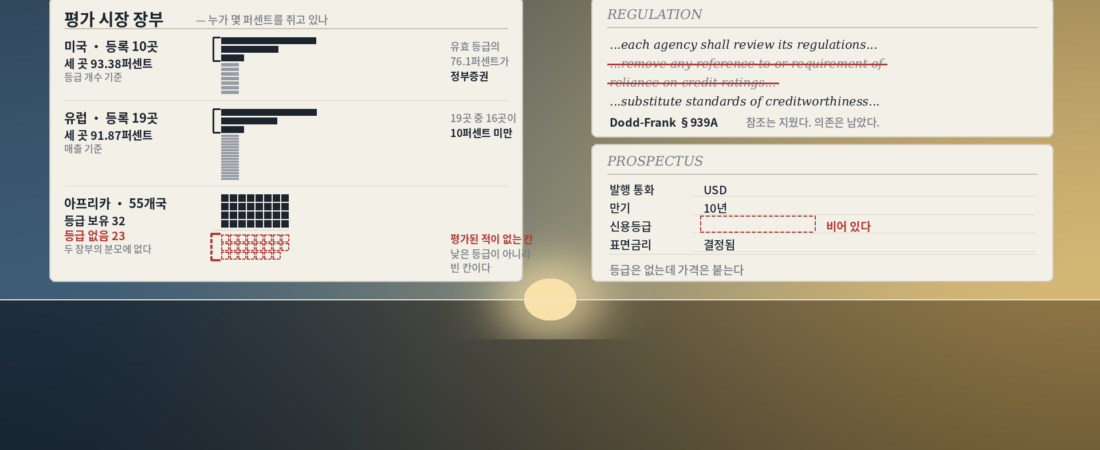
책상에는 국제 채권 발행 안내서의 마지막 교정지가 놓여 있다. 표지 다음 장, 발행 조건이 줄줄이 적힌 표. 그 표의 한 칸이 비어 있다.
‘신용등급’ 칸이다.
등급이 낮아서 비어 있는 것이 아니다. 그 나라를 평가한 기관이 없어서 비어 있다. 담당자는 빈칸 위에 펜을 들었다가 내려놓는다. 적을 것이 없으면 비워 두는 것이 정확한 기재다.
발행일이 오면 그 채권에는 금리가 붙는다. 등급은 없는데 가격은 붙는다. 누군가는 그 빈칸을 읽고 숫자를 매겼다.
누가 매겼을까.
① 세계의 시선 — 아프리카가 자기 등급을 만들기로 했다
2026년 10월 7일, 모리셔스 포트루이스. 아프리카연합이 아프리카신용평가기관(AfCRA)의 출범을 공식 발표했다. 2018년 아프리카연합 총회가 설립을 승인하고, 2023년 7월 나이로비에서 재무장관들이 지지 선언을 채택하고, 2024년부터 2025년까지 아프리카상호평가기구(APRM)가 지배구조와 평가방법론을 설계한 끝에 나온 기관이다.
보도의 조명은 세 방향에서 들어왔다.
첫 번째는 주권의 조명이다. 아프리카의 위험은 아프리카가 평가한다는 선언. 아프리카연합의 자료는 숫자로 그 필요를 설명한다. 대륙의 대외채무 상환액이 2010년 610억 달러에서 2024년 1,630억 달러로 늘었고, 대부분의 나라에서 이자 지급액이 공공 보건이나 교육 예산을 넘어섰다는 것이다.
두 번째는 시장의 조명이다. 출범은 했는데 아직 쓰이지 않았다는 지적. 평가기관의 권위는 설립 인가로 생기지 않는다. 투자자가 그 등급을 보고 값을 매길 때 생긴다. AfCRA의 임시 대표는 2027년 3월이 끝나기 전에 첫 결과를 내놓겠다고 말했다. 15개국과 협의 중이고, 토고·케냐·세이셸·부룬디·모리셔스에서 조사를 진행할 계획이다.
세 번째는 숫자의 조명이다. 아프리카가 다른 지역보다 매년 750억 달러를 이자로 더 낸다는 추정, 부정확하고 맥락이 빈약한 국가등급 때문에 아프리카가 연 745억 달러를 잃는다는 유엔 추정이 인용됐다.
세 조명의 각도는 달랐지만, 켜진 전제는 하나였다. 문제는 등급이 틀렸다는 것이고, 해법은 더 정확한 등급이다.
그 전제 아래에서는 보이지 않는 숫자가 하나 있다. 23이다.
② 또 하나의 세계 — 세 개의 장부를 나란히 펼친다
평가 시장을 보는 가장 빠른 방법은 각국 감독기관이 매년 작성하는 장부를 펼치는 것이다. 장부는 세 권이 있다. 두 권은 오래됐고, 한 권은 아직 첫 장이다.
첫 번째 장부 — 미국
미국 증권거래위원회에 등록된 신용평가기관(NRSRO)은 2025년 12월 31일 기준 10곳이다. 열 곳이 등록돼 있고, 그중 큰 세 곳이 2024년 12월 31일 기준 유효 등급 전체의 93.38퍼센트를 차지한다. 2023년의 94.15퍼센트에서 0.77퍼센트포인트 내려온 숫자다.
같은 보고서에 더 중요한 줄이 있다. 보고된 유효 등급의 76.1퍼센트가 정부증권 등급이다. 그리고 정부증권을 제외하고 다시 계산하면 세 곳의 순위가 흔들린다. 한 곳은 점유율이 18.16퍼센트포인트 떨어지고, 다른 한 곳은 6.26퍼센트포인트 떨어지고, 나머지 한 곳은 7.72퍼센트포인트 올라간다.
같은 세 회사, 같은 날짜, 같은 표다. 무엇을 분모에 넣느냐에 따라 순위가 바뀐다.
두 번째 장부 — 유럽
유럽증권시장감독청은 역내 평가기관의 시장점유율을 매년 공표한다. 2025년판 표에는 19개 기관·그룹이 올라 있다. 매출 기준 점유율은 이렇게 갈린다.
| 평가기관 그룹 | 매출 기준 시장점유율 |
|---|---|
| S&P Global Ratings Europe | 50.42퍼센트 |
| Moody’s Investors Service | 29.63퍼센트 |
| Fitch Ratings Ireland | 11.82퍼센트 |
| DBRS Ratings | 1.99퍼센트 |
| Scope Ratings | 1.23퍼센트 |
| 나머지 14개 기관·그룹 합계 | 약 4.9퍼센트 |
위 세 곳의 합은 91.87퍼센트다.
두 장부가 같은 말을 하는 자리
여기서 멈춰야 한다. 두 장부는 서로 다른 것을 센다. 미국의 장부는 등급의 개수를 세고, 유럽의 장부는 매출을 센다. 단위가 다르면 비교할 수 없는 숫자다.
그런데 두 숫자가 비슷하다. 93.38퍼센트와 91.87퍼센트. 그리고 상위 세 칸에 적힌 이름이 같다.
다른 자로 재도 같은 자리에 같은 세 이름이 나오면, 그것은 측정의 문제가 아니다. 구조다.
지워진 참조
두 제도는 이 구조를 각자의 방식으로 다뤘다. 둘 다 감독이 아니었다.
유럽은 권고를 택했다. 신용평가기관 규정(1060/2009) 제8d조는, 둘 이상의 평가기관을 선임하려는 발행자에게 시장점유율 10퍼센트 이하인 기관을 한 곳 이상 선임하는 것을 고려해야 한다고 적는다. 고려하지 않으면 어떻게 되는가. 그 결정을 문서로 남겨 두면 된다. 의무의 동사는 ‘고려’이고, 지키지 않았을 때의 조치는 ‘기록’이다.
미국은 삭제를 택했다. 도드-프랭크법 제939A조는 모든 연방기관에, 법 시행 후 1년 안에 자기 규정을 검토해 신용등급에 대한 모든 참조와 의존 요구를 제거하고, 그 자리에 대체 신용도 기준을 넣으라고 명령했다. 국가가 민간에 내준 위임을 스스로 거둬들인 것이다.
그리고 2024년 12월 31일, 세 곳이 93.38퍼센트를 쥐고 있다.
지운 것은 참조였고, 남은 것은 의존이었다.
세 번째 장부 — 줄이 없는 23개
아프리카연합의 자료는 아프리카 55개국 중 32개국만이 큰 세 곳의 등급을 갖고 있고, 23개국은 등급이 없다고 적는다.
이 23은 ‘낮은 등급’이 아니다. 등급이라는 칸 자체가 비어 있는 나라들이다. 글 맨 앞의 발행 안내서, 그 빈칸의 나라들이다.
AfCRA는 이 자리를 채우려 한다. 정부는 지분을 가질 수 없고, 기관은 민간 주도로 자체 재원으로 운영된다고 명시돼 있다. 그리고 첫 사업은 의뢰등급이다. 정부가 평가 비용을 내고, 자료와 면담을 제공하고, 등급을 받는다.
여기서 한 칸이 겹친다. 등급을 받는 쪽이 등급의 비용을 낸다. 기존 세 곳의 사업 모델을 두고 반복적으로 제기돼 온 바로 그 구조다. 새 평가기관은 그 구조를 피해서 출발하지 않았다. 같은 구조 위에서, 다른 자리에서 출발했다.
그리고 분모
93.38퍼센트와 91.87퍼센트의 분모에는 그 23개국이 없다.
등급이 없는 나라는 점유율 계산에 들어가지 않는다. 평가되지 않은 것은 평가 시장의 통계에 잡히지 않는다. 집중도를 재는 모든 숫자는 ‘이미 평가된 것’을 분모로 쓴다.
그리고 두 숫자를 겹쳐 놓으면 한 가지가 더 보인다. 미국 장부에서 유효 등급의 76.1퍼센트가 정부증권 등급이었다. 세 곳의 지배력이 가장 두꺼운 자리가 바로 국가와 공공 부문의 채무를 평가하는 자리라는 뜻이다. 그 자리에서 아프리카 23개국은 평가 대상이 아니다.
지배력이 가장 센 시장에서, 가장 평가가 필요한 쪽이 빠져 있다. 이것은 모순이 아니다. 평가는 수요가 있는 곳에서 공급되고, 수요는 발행 규모를 따라간다. 등급은 돈이 큰 쪽으로 먼저 간다. 작은 발행자는 틀린 등급을 받는 것이 아니라 순서에서 뒤로 밀린다.
이 사이트는 전에도 같은 모양을 한 번 봤다. 세계 화물선 선복량의 90퍼센트 이상이 열두 곳의 민간 단체 기준으로 검사받는다는 숫자, 그 90퍼센트가 톤수의 분모였다는 이야기다(EP.016 — 증서를 쓰는 손). 그때 표의 마지막 줄에는 이름이 없었다. 여기서는 줄 자체가 없다.
③ AURA의 시선 — 감독의 대체물
평가를 민간에 맡긴 제도가 평가자를 통제하는 방법은 셋이었다. 셋 중 어느 것도 감독이 아니다.
삭제. 미국은 자기 규칙에서 등급을 지웠다. 국가가 등급을 인용하지 않으면 등급의 공적 권위가 줄어든다는 설계다. 규칙에서는 사라졌고 시장에서는 남았다.
권고. 유럽은 작은 평가기관을 쓰라고 권했다. 강제가 아니라 고려였고, 위반이 아니라 기록이었다. 그 조항 아래에서 세 곳의 합계는 91.87퍼센트다.
신설. 아프리카는 네 번째 평가기관을 만들었다. 평가자를 감독하는 대신 평가자를 늘리는 길이다.
세 방법의 공통점은 분명하다. 아무도 “평가자를 누가 평가하는가”에 답하지 않았다. 대신 셋 다 공급을 늘리거나 수요를 줄이는 쪽으로 움직였다. 경쟁이 감독의 대체물로 쓰이고 있다.
기업에게. 우리 회사가 받은 등급을 볼 때 확인할 칸은 등급 기호가 아니다. 누가 그 평가를 의뢰했고 누가 비용을 냈는가다. 의뢰등급과 무의뢰등급은 같은 기호로 적히지만 같은 서류가 아니다.
투자자에게. 점유율 숫자를 볼 때는 분모를 먼저 본다. 93.38퍼센트는 등급 개수의 몫이고, 그 개수의 76.1퍼센트가 정부증권이다. 정부증권을 빼면 세 곳의 순위가 최대 18.16퍼센트포인트 움직인다. 같은 회사의 지배력이 상품에 따라 다르다는 뜻이다.
무역·물류 실무자에게. 거래 상대의 등급이 없다는 것은 ‘위험이 낮다’가 아니다. ‘측정되지 않았다’다. 그런데 신용 한도나 보증을 심사하는 쪽은 측정되지 않은 상대를 보수적으로 잡는다. 그래서 등급이 없는 쪽이 등급이 낮은 쪽보다 비싸게 빌리는 일이 생긴다. 명단에 없다는 것이 안전을 뜻하지 않는다는 이야기는 이 사이트에서 다룬 적이 있다(제재 명단에 없는데 송금이 막히는 이유). 등급에서는 그 방향이 한 번 더 뒤집힌다. 명단에 없으면 거절당하고, 등급이 없으면 더 비싸진다.
정책에게. 이 자리는 답하지 않고 질문으로 남긴다. 평가기관을 하나 더 만드는 일은 평가의 질을 높이는가, 아니면 평가되지 않은 자리를 그대로 둔 채 평가된 자리의 경쟁만 늘리는가.
AURA Insight
등급은 의견이다. 그런데 제도는 오래 그것을 사실처럼 썼다. 규칙에 인용하고, 한도에 반영하고, 담보 적격 여부에 넣었다. 그 인용을 거둬들인 것이 미국의 선택이었다. 2024년 말의 숫자는 그 선택의 결과를 보여 준다. 규칙에서 지워도 93.38퍼센트는 그대로였다.
의견이 제도에 들어가면 사실이 되고, 제도에서 나와도 습관으로 남는다. 습관은 규칙보다 천천히 바뀐다.
그래서 아프리카의 선택은 합리적이다. 습관을 바꿀 수 없으면 습관이 참조하는 목록을 늘리는 쪽이 빠르다. 다만 그 목록에 이름을 올리려면 먼저 시장이 그 이름을 읽어 줘야 한다. AfCRA가 첫 등급을 내놓는 시점은 2027년 3월이 끝나기 전으로 예고됐다. 그 등급이 발행 금리를 움직였는지는 그 뒤에 측정된다. 등급은 발표로 완성되지 않고 인용으로 완성된다.
세계를 이해하는 것은 더 많은 뉴스를 읽는 일이 아니다. 숫자를 볼 때마다 그 숫자의 분모를 묻는 일이다. 93.38퍼센트와 91.87퍼센트는 평가 시장의 집중도를 말해 주지만, 평가되지 않은 23개국에 대해서는 아무 말도 하지 않는다. 그 나라들은 그 숫자가 틀렸다고 항의할 자격조차 없다. 통계에 들어가 있지 않기 때문이다.
등급이 없는 나라는 가장 낮은 등급을 받은 나라가 아니다. 그 나라는 표에 줄이 없다. 그런데 줄이 없는 나라도, 매일 아침 누군가에게 이자를 낸다.
AURA Question
당신의 거래 상대 중에, 등급이 없다는 이유로 ‘확인된 것 없음’ 칸에 들어가 있는 이름이 있지 않은가.
함께 읽으면 좋은 글
- 세 개의 시선 EP.016 — 증서를 쓰는 손
- 세 개의 시선 EP.012 — 81척의 이름
- 배의 기국이 그레이 리스트면 무엇이 달라지나 — 백·그레이·블랙 읽는 법
- 우리 회사도 거래 거절을 당할 수 있나 — 제재 명단에 없는데 송금이 막히는 이유
- 근원물가는 무엇을 빼고 센 숫자인가
- 최고가격제가 물가를 낮췄다는 걸 어떻게 아나 — 측정값과 ‘없었다면’의 숫자
English Edition — The Country That Erased Ratings, the Continent Building One
Three Perspectives, EP.017 — On who rates the raters, and on the countries that have no row in the table.
A debt management office, somewhere, before dawn.
On the desk sits the final proof of an international bond prospectus. On the page after the cover, a table of issue terms. One cell in that table is empty.
The cell is marked “credit rating.”
It is empty not because the rating is low. It is empty because no agency has rated the country. The official lifts a pen over the blank and puts it down again. When there is nothing to enter, leaving it blank is the accurate entry.
Days later, the bond carries a yield. There is no rating, and yet there is a price. Someone read that empty cell and attached a number to it.
Who did?
I. The Global Perspective — A continent decides to rate itself
On 7 October 2026, in Port Louis, Mauritius, the African Union announced the launch of the Africa Credit Rating Agency. The AU Assembly endorsed its creation in 2018. Finance ministers adopted a supporting declaration in Nairobi in July 2023. Between 2024 and 2025 the African Peer Review Mechanism built its governance and its methodology.
Coverage arrived from three directions.
The first was sovereignty. African risk should be priced by Africa. The AU’s own material makes the case in numbers: the continent’s external debt service rose from US$61 billion in 2010 to US$163 billion in 2024, and in most countries interest payments now exceed public spending on health or on education.
The second was the market. The agency exists; it is not yet used. Authority does not come from a licence. It comes from the moment an investor prices a bond off your opinion. The interim chief executive said results would be released before the end of March 2027. Talks are under way with fifteen sovereigns, with research planned in Togo, Kenya, Seychelles, Burundi and Mauritius.
The third was arithmetic. Estimates that African economies pay roughly $75 billion a year more in interest than borrowers elsewhere; a UN estimate that inaccurate, context-poor sovereign ratings cost the continent about $74.5 billion a year.
Three different angles of light. One shared premise beneath all of them: the problem is that the ratings are wrong, and the solution is more accurate ratings.
Under that premise, one number stays dark. Twenty-three.
II. The Other World — Three ledgers, opened side by side
The fastest way to see this market is to open the ledgers that supervisors publish every year. There are three. Two are old. One is on its first page.
The first ledger — the United States. Ten credit rating agencies were registered with the Securities and Exchange Commission as of 31 December 2025. Ten are on the register, and the three largest held 93.38 per cent of all outstanding ratings as of 31 December 2024 — down from 94.15 per cent at the end of 2023.
The same report carries a more important line. 76.1 per cent of all reported outstanding ratings are ratings of government securities. Strip those out and the order of the three moves: one firm’s share falls by 18.16 percentage points, another’s by 6.26, and the third’s rises by 7.72.
Same three firms. Same date. Same table. Change the denominator and the ranking changes.
The second ledger — Europe. The European Securities and Markets Authority publishes its market share calculation annually. The 2025 table lists nineteen agencies or groups. By turnover: 50.42 per cent, 29.63 per cent, 11.82 per cent for the three largest — 91.87 per cent together. Sixteen of the nineteen are marked as holding less than 10 per cent.
Where the two ledgers say the same thing. They measure different objects. Washington counts ratings; Brussels counts revenue. Different units cannot be compared. And yet the totals sit beside each other — 93.38 and 91.87 — and the top three names are identical. When two different rulers give the same reading in the same place, that is not a measurement problem. That is a structure.
The erased reference. Each regime addressed the structure in its own way, and neither way was supervision. Europe chose a recommendation: under Article 8d of Regulation 1060/2009, an issuer appointing two or more agencies should consider appointing at least one with no more than 10 per cent of the market. And if it does not? It documents the decision. The verb of the duty is “consider”; the consequence of declining is a record. Washington chose deletion: Section 939A of the Dodd-Frank Act ordered every federal agency, within one year, to review its regulations, remove every reference to and requirement of reliance on credit ratings, and substitute standards of creditworthiness of its own. The state took back the delegation it had granted.
And on 31 December 2024, three firms held 93.38 per cent.
What was erased was the reference. What remained was the reliance.
The third ledger — the twenty-three with no row. AU material records that of Africa’s 55 states, only 32 carry ratings from the three largest agencies. Twenty-three have none. These are not low ratings. These are countries for whom the cell itself is blank — the prospectus at the top of this page.
AfCRA means to fill that cell. It is described as private-sector driven and self-funded, and governments may not hold shares. Its first business line is solicited ratings: the government pays, provides data and access, and receives a rating. One column overlaps here. The rated party pays for the rating — precisely the structure repeatedly put to the three incumbents. The new agency did not begin by stepping around it. It began on the same structure, in a different seat.
And the denominator. Those twenty-three are not in the denominator of 93.38 per cent or of 91.87 per cent. What is unrated does not appear in the statistics of the ratings market. Every measure of concentration uses what has already been rated as its denominator. This magazine has seen that shape before: more than 90 per cent of the world’s cargo tonnage is surveyed against the rules of twelve private bodies, and that 90 per cent was a denominator of tonnage. In that table, the last row had no name. Here, there is no row.
Lay the two figures over each other and one more thing appears. In the American ledger, 76.1 per cent of outstanding ratings were ratings of government securities. The place where the three are thickest is the place where sovereign and public debt is assessed. In that place, twenty-three African states are not assessed at all.
The market where dominance is heaviest is the market from which those who most need assessment are missing. This is not a contradiction. Assessment is supplied where it is demanded, and demand follows the size of the issue. Ratings go first to where the money is. A small issuer does not receive a wrong rating; it waits further back in the queue.
III. The AURA Perspective — Competition as a substitute for supervision
A system that delegates assessment to private firms has tried three ways of holding them. None of the three is supervision.
Deletion. America struck ratings from its own rules, on the theory that an opinion the state stops citing loses its public authority. It vanished from the rules and stayed in the market.
Recommendation. Europe asked issuers to consider the smaller firms. Not a command but a consideration; not a breach but a note. Under that article, the three hold 91.87 per cent.
Creation. Africa built a fourth agency — adding a rater instead of supervising the raters.
The common feature is plain. No one answered the question of who rates the raters. All three moved instead to increase supply or reduce demand. Competition is being used as a substitute for supervision.
For companies: the column to check on your own rating is not the symbol. It is who commissioned the assessment and who paid for it. Solicited and unsolicited ratings are written in the same notation and are not the same document.
For investors: read the denominator before the share. The 93.38 per cent is a share of rating counts, and 76.1 per cent of those counts are government securities. Remove them and the ranking shifts by as much as 18.16 percentage points. The same firm’s dominance differs by product.
For trade and logistics practitioners: a counterparty with no rating is not low risk. It is unmeasured. And whoever approves the credit line or the guarantee treats the unmeasured conservatively. That is how the unrated end up borrowing dearer than the poorly rated. Absence from a list has never meant safety. In ratings, the direction folds once more: absent from a sanctions list and you are refused; absent from the rating tables and you simply pay more.
For policy, the question stays open rather than answered. Does adding one more agency raise the quality of assessment — or does it leave the unassessed exactly where they are while sharpening competition over the assessed?
AURA Insight
A rating is an opinion. Institutions used it for a long time as though it were a fact: cited in rules, embedded in limits, written into collateral eligibility. Withdrawing that citation was America’s choice, and the figures for the end of 2024 show what the choice produced. Erased from the rules, 93.38 per cent did not move.
An opinion written into an institution becomes a fact, and when it leaves the institution it stays as a habit. Habits change more slowly than rules.
So Africa’s choice is a rational one. If you cannot change the habit, it is faster to lengthen the list the habit consults. But to get a name onto that list, the market must first agree to read it. AfCRA’s first ratings are promised before the end of March 2027. Whether those ratings moved a yield will be measured after that. A rating is not completed when it is published. It is completed when it is cited.
Understanding the world is not a matter of reading more news. It is a matter of asking, each time a number appears, what sits in its denominator. The figures 93.38 and 91.87 describe the concentration of the ratings market, and they say nothing whatsoever about the twenty-three countries that are not rated. Those countries do not even have standing to object that the number is wrong. They are not inside it.
A country with no rating is not the country with the lowest rating. It has no row in the table. And a country with no row still pays someone interest every morning.
AURA Question
Is there a name among your counterparties that sits in the “nothing found” column only because nobody ever looked?
Sources
사실
- African Union, “The Launch of Africa Credit Rating Agency” (2026년 10월 7일, 모리셔스 포트루이스) — 설립 경과(2018년 총회 승인, 2023년 7월 나이로비 재무장관 선언, 2024~2025년 APRM 설계), 본부 소재지, 민간 주도·자체 재원·정부 지분 보유 불가, 대외채무 상환액 2010년 610억 달러 → 2024년 1,630억 달러, 아프리카 55개국 중 32개국 등급 보유·23개국 미보유.
- U.S. Securities and Exchange Commission, Office of Credit Ratings, 「2025 Staff Report」 — 2025년 12월 31일 기준 등록 NRSRO 10곳. 2024년 12월 31일 기준 대형 3사 유효 등급 점유율 93.38퍼센트(2023년 94.15퍼센트). 보고된 유효 등급 중 정부증권 76.1퍼센트. 정부증권 제외 시 점유율 변동 −18.16 / −6.26 / +7.72퍼센트포인트.
- European Securities and Markets Authority, 「CRA Market Share Calculation 2025」(ESMA84-900617762-2652) — 19개 기관·그룹, 매출 기준 점유율 50.42 / 29.63 / 11.82퍼센트(합계 91.87퍼센트), 16곳이 10퍼센트 미만. 법적 근거 규정 (EC) No 1060/2009 제8d조 — 둘 이상 선임 시 10퍼센트 이하 기관 선임을 ‘고려’해야 하고, 고려하지 않으면 그 결정을 문서화한다.
- Board of Governors of the Federal Reserve System, 「Report to the Congress on Credit Ratings」(2011년 7월) — 도드-프랭크법 제939A조의 내용: 각 연방기관은 법 시행 후 1년 안에 규정을 검토하고, 신용등급에 대한 모든 참조와 의존 요구를 제거하고, 대체 신용도 기준으로 치환하며, 검토 결과를 의회에 보고한다.
- Nairametrics(2026년 11월 3일) — AfCRA 임시 대표 Sifiso Falala의 발언: 2027년 3월이 끝나기 전 첫 결과 공표 목표, 15개국과 협의, 토고·케냐·세이셸·부룬디·모리셔스 조사 계획, 의뢰등급 방식. 인용된 추정치: 아프리카의 연간 추가 이자 부담 약 750억 달러, 유엔 추정 연 745억 달러, 아프리카 부채 약 1조 9,000억 달러.
재현
- 유럽 상위 3사 합계 — 50.42 + 29.63 + 11.82 = 91.87퍼센트. 편집부 산술 확인.
- 미국 대형 3사 점유율 변동 — 94.15 → 93.38, 0.77퍼센트포인트 하락. 편집부 산술 확인.
- 표의 ‘나머지 14개 기관·그룹 합계 약 4.9퍼센트’ — 100에서 상위 5개 기관 합계(50.42 + 29.63 + 11.82 + 1.99 + 1.23 = 95.09)를 뺀 값. 개별 기관 수치의 합이 아니라 잔여값이므로 ‘약’으로 표기했다.
해석
- 글 앞머리의 재무부 자금국 장면은 특정 국가·기관·발행 건을 가리키지 않는 범주 서술이다. ‘등급 칸이 빈 채로 국제 채권이 발행된다’는 상태를 설명하기 위한 구성이며, 실제 특정 사건의 재현이 아니다.
- “다른 자로 재도 같은 세 이름이 나오면 구조다”는 편집부의 해석이다. 두 장부는 분모와 단위가 다르므로 93.38퍼센트와 91.87퍼센트는 산술적으로 비교 가능한 수치가 아니다. 두 숫자를 나란히 놓은 것은 크기를 비교하기 위해서가 아니라 상위 세 칸의 이름이 같다는 사실을 보이기 위해서다.
- “지운 것은 참조였고, 남은 것은 의존이다”는 편집부의 해석이다. 제939A조 시행과 2024년 말 점유율 사이의 인과관계를 입증한 자료는 확인하지 못했다. 규칙상의 참조 제거가 점유율에 어떤 영향을 주었는지는 별도의 실증 연구가 필요한 문제다.
- 의뢰등급 구조에 대한 서술 — ‘등급을 받는 쪽이 비용을 낸다’는 사실 관계는 보도로 확인했으나, 그 구조가 평가의 독립성에 미치는 영향에 대한 판단은 편집부가 내리지 않았다. 구조가 같다는 사실만 적었다.
- ‘등급은 돈이 큰 쪽으로 먼저 간다’, ‘작은 발행자는 순서에서 뒤로 밀린다’는 편집부의 해석이다. 정부증권 비중(76.1퍼센트)과 아프리카 23개국의 미보유 사실을 겹쳐 읽은 추론이며, 평가기관의 수임 순서를 보여 주는 자료를 확인한 것이 아니다.
- ‘등급이 없는 쪽이 등급이 낮은 쪽보다 비싸게 빌리는 일이 생긴다’는 편집부의 해석이다. 심사 실무의 보수적 처리 경향을 근거로 한 설명이며, 특정 국가·기업의 조달 금리를 비교한 실측이 아니다. 투자 판단이나 신용 심사의 기준으로 쓸 수 없다.
- 이 글은 제도와 통계 구조의 설명이며, 특정 평가기관·국가·증권에 대한 평가나 투자 권유가 아니다. 등록 기관 수, 점유율, 규정 조문과 그 적용 범위는 변경될 수 있으니 각 감독기관의 공표 자료 원문으로 확인해야 한다.
불확실
- 유럽 표의 참조 연도 — 보고서 본문은 2024년 감사받은 재무제표를 기준으로 한다고 적는데, 표 머리글은 ‘Market Share 2025’로 표기돼 있고 각주의 기준일 표기도 서로 다르다. 보고서 안에서 이 차이가 조정돼 있지 않다. 본문에서는 보고서의 판본 명칭(2025년판)으로만 표기했다.
- 아프리카연합 자료의 ’32개국 등급 보유·23개국 미보유’는 기준일이 명시되지 않았다. 등급 보유 여부는 평가기관의 신규 부여·철회로 바뀔 수 있다.
- 연 750억 달러·연 745억 달러 추정치는 산식과 가정이 공표되지 않았다. 추정의 성격은 이 사이트에서 따로 다룬 바 있다(측정값과 ‘없었다면’의 숫자). 두 수치는 인용 대상이며 편집부가 재현하지 못했다.
- 미국 보고서의 기관별 점유율 수치는 본문 표가 아닌 차트에 담겨 있어 개별 기관의 정확한 퍼센트를 확인하지 못했다. 본문에는 보고서가 문장으로 적은 합계와 변동 폭만 썼고, 어느 회사가 −18.16인지는 적지 않았다.
- AfCRA의 자본 구조·재원 규모·초기 인력은 공표된 수치를 확인하지 못했다.
- AfCRA의 첫 등급 공표 시점은 임시 대표의 목표 발언이며 확정 일정이 아니다.