검사원이 망치를 들고 선체를 두드린다. 소리를 듣고, 초음파 측정기를 댄다. 화면에 숫자가 뜬다. 강판 두께, 단위는 밀리미터다.
그가 재고 있는 배는 오래 제재 명단에 있었다. 어느 날 그 이름이 명단에서 지워졌다.
측정기의 숫자는 그 소식을 모른다.
2026년 10월, 미국이 제재 유조선을 합법 선단으로 되돌리는 방안을 꺼냈다. 유조선 운임이 사상 최고 구간에 올라 있고, 그 운임이 기름값과 물가로 넘어오고 있기 때문이다. 보도는 한 방향으로 모였다. 제재를 풀면 배가 돌아오고, 배가 돌아오면 운임이 내려간다.
그 문장에는 생략된 단계가 있다. 명단에서 지워진 배가 실제로 화물을 실으려면, 국가가 아닌 세 곳의 허락이 더 필요하다.
① 세계의 시선 — 모두가 척수와 달러를 센다
워싱턴은 전환으로 말했다. 미국 에너지장관 크리스 라이트는 2026년 10월 19일 뉴욕의 한 금융사 행사에서 말했다. “제가 ‘나쁜 놈들 함대’라고 부르는 쪽에서 ‘좋은 놈들 함대’로 배 몇 척을 옮기려 합니다.” 그는 “다크 탱커를 합법 탱커로 전환하는 것”이라고 했고, 다크 함대 규모를 약 1,600척으로 제시하며 수십에서 수백 척이 합법 운송에 합류할 수 있다고 했다. 동시에 그는 이것이 러시아·이란산 원유를 실은 배의 제재를 면제해 주는 절차는 아니라고 선을 그었다. 그 배들은 “더 이상 제재 대상 석유를 싣지 않을 것”이라고 했다.
로이터는 검토로 말했다. 2026년 10월 19일자 로이터 보도에서 미국 관리는 개별 다크 함대 유조선의 제재를 풀어 정상 운영자에게 넘기는 방안이 논의되고 있다고 했고, 그것이 “운임을 낮추고 물량을 늘릴 것”이라고 했다. 에너지부는 그림자 함대 제재 완화가 러시아의 석유 이동을 돕지는 않는다는 입장을 냈다. 장관은 되고 있다고 말했고, 관리는 논의 중이라고 말했다. 같은 날짜의 두 문장이다. 어느 쪽도 아직 틀리지 않았다.
시장은 날짜와 스프레드로 말했다. 보도가 나온 뒤 운임 선물(FFA)이 내렸다. 미 걸프만에서 유럽으로 가는 아프라맥스급 운임은 30포인트 떨어졌다. 서부텍사스유의 브렌트 대비 할인폭은 10월 중순 한때 14.17달러까지 벌어져 다섯 달 넘는 기간의 최대치를 찍었다가 약 10.42달러로 좁혀졌다. 운임이 내리자 미국산 원유가 다시 팔릴 만해졌다는 뜻이다. 10월 19일 브렌트는 배럴당 109.3달러, 서부텍사스유는 98.42달러로 마감했다.
한국 언론은 기름값으로 말했다. 국내 보도의 제목은 “고유가에 제재 완화 검토”, “경유 가격 잡기”였다. 프레임은 물가다. 틀린 각도가 아니다. 유조선 운임은 결국 주유소까지 내려온다.
네 개의 조명이 각자 다른 각도에서 켜졌지만, 비추는 전제는 하나다. 제재는 스위치다. 끄면 배가 돌아오고, 배가 돌아오면 운임이 내려간다. 그래서 모두가 세는 단위도 두 개뿐이다. 척수와 달러.
그런데 같은 달에, 다른 나라는 같은 스위치를 반대 방향으로 돌렸다. 그리고 아무도 세지 않는 숫자가 하나 더 있다. 명단에서 이름이 지워졌는데도 끝내 뜨지 못하는 배다.
② 또 하나의 세계 — 한 척이 통과해야 하는 여섯 개의 문
1. 분모부터 어긋난다
이 사안에는 숫자가 다섯 개 돌아다닌다.
| 숫자 | 무엇을 센 것인가 | 출처 |
|---|---|---|
| 800~1,000척 | 그림자 함대 전체의 통상 추정 규모 | 업계 통용 추정 |
| 약 1,600척 | 미 에너지장관이 제시한 다크 함대 규모 | 2026년 10월 19일 발언 |
| 약 160척 | 미 재무부 해외자산통제국이 지정한 초대형유조선. 상선대의 약 22퍼센트 | 선박 추적사 Kpler |
| 약 46척 | 그 160척 중 선령 20년을 넘긴 배 (27퍼센트) | Kpler |
| 약 24척 | 선령과 소유 제약을 적용하고 이란 국영 유조선사 보유분을 제외했을 때 주류 교역에 복귀할 수 있는 배 | Kpler |
이 숫자들은 서로 빼면 안 된다. 세는 대상이 다르다. 800과 1,600은 함대 전체의 추정치이고, 160은 특정 선종의 지정 선박 수이며, 24는 그 160척에 두 개의 필터를 걸고 남은 수다. “1,600척 중 24척만 돌아온다”는 문장은 분모를 잘못 쓴 문장이다.
분모가 세 개라는 사실 자체가 이 사안의 성격을 말해 준다. 세는 대상의 정의가 아직 합의되지 않았다. 그런 상태에서 가장 먼저 합의되는 것은 늘 방향이고, 가장 늦게 합의되는 것은 숫자다.
2. 명단을 지우는 쪽은 국가, 증서를 주는 쪽은 민간이다
배가 상업 운항을 하려면 선급 증서가 있어야 한다. 선급은 국가 기관이 아니다. 민간 기술 단체다. 규칙을 쓰고, 배를 검사하고, 기준에 맞으면 증서를 낸다. 경찰권은 없다. 그 권위는 보험사와 용선주와 기국이 그 검사 결과를 믿어 주는 데서 나온다.
국제선급연합회(IACS) 회원사들이 세계 상선 톤수의 약 90퍼센트를 검사한다. 선급의 상태는 계단으로 되어 있다. 정상, 조건부, 권고, 정지, 철회. 정지되면 복구 전까지 사실상 운항할 수 없고, 철회되면 처음부터 다시 등록해야 한다.
그리고 다시 들어오는 문이 좁다. IACS 회원사끼리 선급을 옮길 때도 받는 쪽이 자체 입회 검사를 한다. 비IACS 선급에서 넘어오면 설계 심사와 추가 검사가 붙는다. 검사 기록, 강판 교체, 밀린 정기 검사가 쌓여 있으면 선급이 그 배를 받기 전에 상당한 작업을 요구한다.
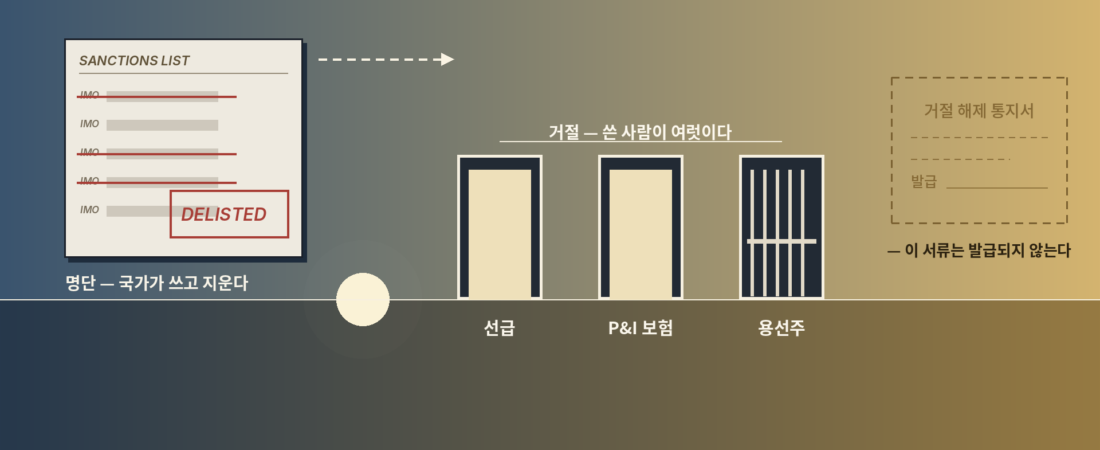
국가는 명단에서 이름을 지울 수 있다. 증서를 발급하는 것은 국가가 아니다.
3. 보험 약관은 선급을 전제로 쓰여 있다
국제 P&I 그룹의 열두 개 클럽이 세계 외항 톤수의 약 90퍼센트를 커버한다. 그 약관은 IACS 선급을 표준 전제 조건으로 적는다. 선급이 철회되면 보장은 갱신 시점에, 일부 문구에서는 즉시 끊긴다.
여기에 이 계획의 구조적 모순이 하나 있다. 제재 선박을 투자자가 사들여 수리해 합법 선박으로 만든다는 구상의 첫 단계는 소유권 이전이다. 그런데 P&I 약관은 별도 합의가 없으면 소유 또는 관리가 바뀔 때 보장이 종료된다고 적는다. 매수가 곧 보험 공백의 시작이다. 새 주인은 자기 이름으로 가입을 처음부터 다시 해야 한다.
그 가입이 쉽지 않다는 증거는 이미 숫자로 남아 있다. 2026년 2월 로이즈 리스트 보도에서, 발트해 유조선 통항의 약 3분의 1이 러시아 또는 러시아계 보험사의 증서를 들고 있었다. 2026년 6월 선박 추적 자료에서는, 그 달 새로 그림자 함대로 분류된 선박들의 가장 흔한 공통점이 국제 P&I 그룹 보험의 부재였다. 그림자 함대를 식별하는 지표가 무기나 깃발이 아니라 보험 증서의 빈칸이라는 뜻이다.
4. 용선주는 서류를 다 봐도 거절할 수 있다
선급과 보험을 다 갖춘 배도 화물을 실으려면 용선주의 승인을 받아야 한다. 유조선 검사 정보 공유 체계(OCIMF SIRE 2.0)에서 검사 데이터는 공유되지만, 판정은 각자 한다. 용선주, 터미널, 트레이더가 각각 자기 기준으로 결정한다. 좋은 검사 결과가 용선 계약을 보장하지 않는다.
이것이 이 이야기의 가장 단단한 층이다. 제재에는 해제 절차가 있다. 해외자산통제국에는 지정된 선박이 삭제를 청원하는 행정 재심 절차가 있다. 선급에도 재등록 절차가 있다. 보험에도 가입 절차가 있다.
그런데 용선주의 거절에는 절차가 없다. 거절은 제도가 아니라 판단이고, 판단에는 심판이 없다.
5. 같은 달, 스위치는 반대로도 돌아갔다
2026년 10월 2일, 일본 각의가 러시아 그림자 선단을 직접 겨냥한 첫 제재를 의결했다. 선박 35척. 보도에 따르면 원유·석유제품 유조선 31척과 로로선·일반화물선 4척, 합계 약 337만 재화중량톤이다. 함께 러시아 군 관련 법인 33곳과 개인 9명의 자산이 동결됐고, 제재 회피를 도운 아랍에미리트·튀르키예의 4개 법인이 수출 통제에 추가됐다.
이 조치의 형태를 보는 것이 중요하다. 일본은 그 배의 항행을 금지하지 않았다. 대신 일본의 사업자가 그 배에 운송·도선·수리·보험·선원 모집 서비스를 제공하려면 정부 허가를 받도록 했다. 선박 매매·용선에 딸린 대출과 보증도 허가 대상이다. 10월 2일 이전에 체결된 계약은 11월 1일까지 이행을 끝내는 경우에만 예외다.
금지가 아니라 허가다. EP.013에서 본 구조가 반대 방향으로 쓰였다. 그때는 통항을 허가로 관리하는 쪽이었고, 이번에는 서비스를 허가로 관리하는 쪽이다. 같은 도구로 통로를 열 수도 있고 좁힐 수도 있다.
그리고 지정 방식이 결정적이다. 일본은 선박을 IMO 번호로 지정했다. 이름을 바꾸고 깃발을 바꾸고 주인을 바꿔도 번호는 그 배에 평생 붙어 있다. 규제가 이름을 부르면 개명으로 피할 수 있다. 번호를 부르면 피할 수 없다. EP.012가 명단의 작동을 봤다면, 이것은 명단이 개명을 이기는 방식이다.
그래서 한 척의 배가 동시에 두 상태에 놓일 수 있다. 미국 명단에서는 지워졌고, 일본의 수리조선소에는 허가 없이 들어갈 수 없다. 유럽연합과 영국의 지정은 별도로 살아 있으므로 각각 따로 확인해야 한다. 제재는 한 장의 명단이 아니라 여러 장의 명단이고, 지우는 쪽과 더하는 쪽이 같은 달에 동시에 움직인다.
6. 값이 비싼 것과, 값을 매기지 않는 것
운임은 비싸졌다. 한 분석 자료에 따르면 중동에서 아시아·유럽으로 가는 초대형유조선 운임은 배럴당 20~40달러 구간으로, 위기 전 2~4달러의 약 열 배다. 정제마진은 무너졌다. 로테르담 복합 정제마진은 2026년 10월 5일 배럴당 마이너스 10.95달러였고, 싱가포르는 9월 10일 마이너스 4달러 아래로 내려갔다. 북해 브렌트 현물은 10월 초 배럴당 154달러를 넘어 선물보다 약 50퍼센트 높았다. 유럽 정유사들이 짧은 항로의 원유를 사려고 값을 올려 부른 결과다.
이 숫자들은 모두 값이 매겨진 것이다. 비싸지만 살 수 있다. 운임도, 전쟁위험보험료도, 정제마진의 손실도 숫자로 적힌다. 적히면 계약서에 넣을 수 있고, 계산에 넣을 수 있고, 가격에 얹을 수 있다.
선급 증서는 값이 아니다. 보험 인수 거절도 값이 아니다. 용선주의 심사 탈락도 값이 아니다. 돈을 더 내도 사지 못하는 칸이 따로 있다.
한 척의 가격이 이 간격을 보여 준다. 2006년에 지어진 초대형유조선 한 척이 2026년 4월 6,050만 달러에 팔렸고, 같은 해 10월 1억 1,700만 달러에 다시 팔린 것으로 보도됐다. 여섯 달에 가격이 거의 두 배다. 그러나 그 배가 어느 선급에 등록됐고 어느 클럽에 가입했는지는 공개 자료로 확인되지 않는다. 값은 공시되고 자격은 공시되지 않는다.
③ AURA의 시선 — 제재는 명단이고, 거절은 시장이다
제재와 거절은 같은 결과를 낸다. 배가 화물을 싣지 못한다. 그러나 둘은 전혀 다른 물건이다.
제재는 명단이다. 한 기관이 쓰고, 그 기관이 지운다. 주소가 있고, 절차가 있고, 청원할 창구가 있다. 쓴 쪽을 찾아가면 된다.
거절은 시장이다. 쓴 사람이 여럿이다. 선급 하나, 클럽 하나, 용선주 수십, 터미널 수백. 지우려면 그 전부를 각각 설득해야 한다. 그리고 그들 중 누구도 “거절을 해제한다”는 문서를 발급하지 않는다. 거절은 발급되지 않으므로 해제될 수도 없다.
이것은 EP.014에서 본 명제의 다음 층이다. 그때의 발견은 제도가 들어올 때와 나갈 때 같은 문을 쓰지 않는다는 것이었다. 여기서 한 칸 더 간다. 나가는 문은 국가가 지키고 있지 않다. 국가는 문을 열어 줄 수 있지만, 문 밖에 서 있는 것은 민간이다.
수출기업에게. 이 이야기는 운임 전망이 아니다. 점검 항목이다. 우리 화물을 실은 배가 어느 선급에 등록돼 있고 어느 클럽에 가입해 있는지, 계약서에는 적혀 있지 않다. 인코텀즈는 보험료를 누가 내는지를 정하지만, 선박의 자격을 정하지는 않는다. 보험료를 우리가 냈는데 그 보험이 그 배에 적용되지 않는 상황은 조건절 하나로 갈린다.
투자자에게. 어떤 분모로 모델을 짰는지가 전부다. 1,600척으로 짠 모델과 24척으로 짠 모델은 다른 자산을 평가한 것이다. 그리고 선박 가치의 상승분이 수익이 되는 것은 자격 회복 비용을 차감한 뒤다. 입거 수리, 강판 적립, 밀린 검사, 기국·선급·법률 비용, 그리고 그 기간의 운항 중단. 이 항목들은 선가에 포함되지 않는다.
물류 실무자에게. 배를 고르는 기준에 “제재 명단에 없음”을 넣는 것으로는 부족하다. 명단에 없고, 선급이 유효하고, 국제 그룹 클럽 증서가 있고, 용선주 심사를 통과한 배가 다른 배다. 확인은 하나가 아니라 넷이다. 그리고 넷째가 가장 늦게 확인되고 가장 자주 무너진다.
정책의 자리는 답하지 않고 질문으로 남긴다. 제재를 설계할 때, 그 해제까지 설계했는가. 명단은 국가가 만들었고, 거절은 민간이 만들었다. 제재를 푸는 권한은 국가에 있는데, 거절을 푸는 권한은 어디에도 없다. 제도의 입구에는 설계자가 있다. 출구에는 누가 있는가.
AURA Insight
제재는 효과를 민간에 위탁해 작동한다. 국가가 배를 붙잡는 것이 아니다. 명단을 쓰고, 보험사와 선급과 은행이 그 명단을 읽고 손을 떼는 것이다. 그 위탁이 제재를 강력하게 만든다. 군함 한 척 보내지 않고 함대를 세울 수 있다.
그런데 위탁한 것은 되돌려 받기 어렵다. 명단을 지우는 것은 국가의 서명 한 번이면 되지만, 손을 뗀 쪽이 다시 손을 뻗을지는 그들이 정한다. 그들은 제재를 보고 손을 뗀 것이 아니라, 제재가 알려 준 사실을 보고 손을 뗐다. 선령, 정비 기록의 공백, 깃발을 몇 번 바꿨는지, 위치 신호가 끊긴 구간. 명단이 지워져도 그 사실들은 지워지지 않는다.
그래서 이 사안의 진짜 숫자는 운임도 척수도 아니다. 명단과 거절 사이의 간격이다. 160과 24 사이의 136척이 그 간격에 서 있다. 그 136척은 제재를 받고 있지 않으면서도 뜨지 못한다. 어느 명단에도 없는 상태로, 어느 항로에도 없다.
뉴스는 스위치를 보도한다. 스위치는 한 번에 딸깍 내려간다. 보도하기 쉽고, 날짜가 있고, 발언자가 있다. 그러나 스위치 아래에는 배선이 있고, 배선은 여러 갈래이고, 각 갈래의 끝에는 각자 판단하는 사람이 앉아 있다. 하나를 끄면 전부 꺼지지만, 다시 켜는 스위치는 한 개가 아니다.
세계를 이해하는 것은 더 많은 뉴스를 읽는 일이 아니다. 더 많은 현실을 읽는 일이다. 그리고 여기서의 현실은 이것이다. 명단은 지울 수 있다. 거절은 지울 수 없다.
AURA Question
당신의 일에도, 서류상으로는 풀렸는데 아무도 다시 받아 주지 않는 것이 있지 않은가.
함께 읽으면 좋은 글
- 세 개의 시선 EP.010 — 해협은 열렸다. 그런데 배가 오지 않는다
- 세 개의 시선 EP.012 — 81척의 이름
- 세 개의 시선 EP.013 — 요금표가 없는 톨게이트
- 세 개의 시선 EP.014 — 이긴 쪽이 다시 줄을 선다
- 호르무즈에 이어 홍해까지 — 수출입 실무자 점검 5가지
- 해상운임 지수 3종 차이 — SCFI·WCI·KCCI
- 배의 기국이 그레이 리스트면 무엇이 달라지나 — 백·그레이·블랙 읽는 법 (2026년 기준) — 제재 명단과는 다른 종류의 명단입니다. 성적의 순위가 아니라 입증의 순위로 읽어야 하는 이유를 다룹니다.
English Edition — If the Sanctions Lift, Do the Ships Come Back?
Three Perspectives, EP.015 — On the difference between a list and a refusal
A surveyor taps the hull with a hammer. He listens. Then he presses an ultrasonic gauge against the steel. A number appears on the screen. Plate thickness, in millimetres.
The ship he is measuring spent a long time on a sanctions list. One day its name was struck off.
The number on the gauge does not know that.
In October 2026, the United States floated a plan to move sanctioned tankers back into the legal fleet. Tanker rates sit at record levels, and those rates are travelling into fuel prices and inflation. The coverage converged on one sentence: lift the sanctions, the ships return, the rates come down.
That sentence skips a step. A delisted ship that wants to carry cargo needs permission from three parties, and none of them is a government.
I. The Global Lens — Everyone Counts Hulls and Dollars
Washington spoke in the language of conversion. On 19 October 2026, at a financial-firm event in New York, US Energy Secretary Chris Wright said he intended to move some ships “from what I call the ‘bad-guy fleet’ to the ‘good-guy fleet’,” and described the exercise as “converting dark tankers to legitimate tankers.” He put the dark fleet at roughly 1,600 vessels and said dozens, perhaps hundreds, could join legitimate shipping. He also rejected the reading that this forgives ships carrying Russian or Iranian crude. Those vessels, he said, “will not carry sanctioned oil any more.”
Reuters spoke in the language of deliberation. In reporting from the same window, a US official said talks involved lifting sanctions on individual dark-fleet tankers so they could pass to legitimate operators, which “would lower shipping rates and increase flows.” The Department of Energy said easing shadow-fleet sanctions would not help Russia move oil. The secretary said it is happening. The official said it is being discussed. Two sentences from the same days. Neither is yet wrong.
The market spoke in dates and spreads. Forward freight agreements fell after the reports. Aframax rates from the US Gulf Coast to Europe dropped thirty points. West Texas Intermediate’s discount to Brent, which had widened that week to $14.17 — the widest in more than five months — narrowed to about $10.42. On 19 October, Brent settled at $109.3 a barrel and WTI at $98.42.
The Korean press spoke in the language of the pump. Headlines framed the story as an attempt to hold down fuel and diesel prices. Not the wrong angle. Tanker rates do eventually reach the forecourt.
Four lamps, four angles, one shared premise: a sanction is a switch. Flip it and the ships return; when they return, rates fall. Which is why everyone counts in only two units. Hulls and dollars.
But in the same month, another country turned the same switch the other way. And there is a number nobody is counting: the ship whose name has been erased and which still cannot sail.
II. The Other World — Six Doors One Ship Must Pass
1. The denominators do not agree. Five numbers are circulating. Eight hundred to a thousand vessels, the common industry estimate of the shadow fleet. Roughly 1,600, the figure the US energy secretary gave. About 160 supertankers designated by the Treasury’s Office of Foreign Assets Control, around 22 per cent of the commercial fleet, per the tracking firm Kpler. Of those, about 46 are already more than twenty years old. And about 24 that could return to mainstream trade once age and ownership limits apply and vessels held by Iran’s national tanker company are set aside.
These numbers must not be subtracted from one another. They count different things. “Only 24 of 1,600 will return” is a sentence with the wrong denominator. That three denominators exist tells you what stage this is at: direction is agreed first, numbers last.
2. The state erases the list. A private body issues the certificate. A ship trades on a class certificate, and a classification society is not a government. It is a private technical body. It writes rules, surveys ships, and certifies those that comply. It has no police power. Its authority comes from insurers, charterers and flag states choosing to rely on it. Members of the International Association of Classification Societies class roughly 90 per cent of world merchant tonnage. Class runs on a ladder — in class, conditions, recommendations, suspended, withdrawn. Suspended, a ship generally cannot trade until reinstated. Withdrawn, it must be re-classed from the beginning. And the door back in is narrow: even a transfer between IACS members triggers an entry survey by the receiving society, and a ship arriving from a non-IACS society faces design appraisal and additional surveys. A government can strike a name from a list. A government does not issue the certificate.
3. Insurance wordings are written on top of class. The twelve clubs of the International Group cover roughly 90 per cent of the world’s ocean-going tonnage, and their rules treat IACS class as a standard precondition. Cover can lapse at renewal or, in some wordings, immediately on withdrawal. Here sits the structural problem in the plan. The first step in having investors buy and refit a sanctioned tanker is a change of ownership — and club rules provide that cover ends on a change of owner or manager unless otherwise agreed. The purchase is itself the moment the insurance stops. The new owner must enter the ship again, in its own name. That this is hard is already visible in the data. Lloyd’s List reported in February 2026 that about a third of Baltic tanker transits carried certificates from Russian or Russian-linked insurers. Tracking data from June 2026 found the most common marker among newly classified shadow-fleet vessels was the absence of International Group cover. The identifying feature of a shadow fleet is not a weapon or a flag. It is a blank line on an insurance certificate.
4. A charterer may read every document and still say no. A ship with class and cover still needs a charterer’s approval. Under the tanker inspection regime known as SIRE 2.0, inspection data is shared but each party decides for itself. Charterers, terminals and traders each apply their own standard. A good inspection does not produce a fixture. This is the hardest layer in the story. Sanctions have an exit: OFAC runs an administrative reconsideration process through which a designated vessel may petition for removal. Class has a re-entry procedure. Insurance has an application. A charterer’s refusal has no procedure at all. A refusal is not an institution but a judgment, and a judgment has no appellate court.
5. In the same month, the switch also turned the other way. On 2 October 2026, Japan’s cabinet approved its first sanctions aimed directly at Russia’s shadow fleet: 35 vessels, reported as 31 crude and product tankers and four ro-ro or general-cargo ships, about 3.37 million deadweight tonnes. Thirty-three Russian military-linked entities and nine individuals were frozen, and four entities in the UAE and Türkiye were added to export controls. Read the form of the measure. Japan did not forbid these ships to sail. It required Japanese providers of transport, pilotage, repair, insurance and crew recruitment to obtain government permission before serving them; loans and guarantees tied to sale or charter fall under the same permission. Contracts signed before 2 October are exempt only if performed by 1 November. Not a prohibition — a permit. The structure of EP.013 running in the opposite direction: there, permits managed passage; here, permits manage services. The same instrument widens a channel or narrows it. And the method of designation decides the rest: Japan designated the ships by IMO number. Rename, reflag, resell — the number stays with the hull for life. A rule that calls a name can be escaped by renaming. A rule that calls a number cannot. So one ship can hold two statuses at once: struck from an American list, barred without a licence from a Japanese repair yard. EU and UK designations run separately and must be checked separately. Sanctions are not one list but several, and in the same month one authority subtracts while another adds.
6. What is expensive, and what is not priced at all. Freight is expensive. One analysis puts supertanker rates from the Middle East to Asia and Europe at $20–40 a barrel against a pre-crisis $2–4 — roughly tenfold. Refining margins have collapsed: the Rotterdam complex margin stood at minus $10.95 a barrel on 5 October 2026, and Singapore fell below minus $4 on 10 September. North Sea Brent traded above $154 a barrel in early October, some 50 per cent above the futures price, as European refiners bid up short-haul crude. Every one of those numbers is a price. Expensive, but purchasable. Freight, war-risk premium, margin loss — all of it can be written down, and what can be written down can be put in a contract, a model, a tariff. A class certificate is not a price. A declined insurance application is not a price. Failing a charterer’s vetting is not a price. There is a column you cannot buy your way into. One hull shows the gap: a supertanker built in 2006 was reported sold for $60.5 million in April 2026 and resold for $117 million in October. Nearly double in six months. Which society classes it, and which club covers it, cannot be confirmed from public records. The price is published. The qualification is not.
III. The AURA Perspective — A Sanction Is a List. A Refusal Is a Market.
Sanctions and refusals produce the same outcome: the ship does not load. They are entirely different objects.
A sanction is a list. One authority writes it and the same authority erases it. There is an address, a procedure, a window at which to petition. You go back to whoever wrote it.
A refusal is a market. Many parties wrote it — one society, one club, dozens of charterers, hundreds of terminals. To erase it you must persuade each of them, and none of them issues a document called “refusal lifted.” A refusal is never issued, so it can never be withdrawn.
This is the next storey above EP.014. There, the finding was that an institution does not use the same door on the way in and on the way out. Here we go one floor further: the exit is not guarded by the state. A government can open the door. What stands outside it is private.
For exporters, this is not a freight forecast but a checklist. Which society classes the ship carrying your cargo, and which club covers it, is not written in your contract. Incoterms decide who pays the premium, not whether the vessel qualifies. The gap between paying for cover and having cover that applies to that hull turns on a single conditional clause.
For investors, the denominator is the whole argument. A model built on 1,600 and a model built on 24 have valued different assets. And the appreciation only becomes a return after the cost of restoring eligibility: drydock, steel reserve, overdue surveys, flag and class and legal fees, and the idle weeks. None of that sits in the asking price.
For practitioners, “not on a sanctions list” is not a sufficient test. Not listed, validly classed, covered by an International Group club, and accepted by the charterer — four checks, not one. The fourth is confirmed last and fails most often.
The policy chair we leave as a question. When a sanction was designed, was its removal designed? The list was made by states; the refusal was made by markets. The power to lift a sanction sits with a government. The power to lift a refusal sits nowhere. Every institution’s entrance has an architect. Who is standing at the exit?
AURA Insight
Sanctions work by delegating their effect to private hands. A state does not seize the ship. It writes a list, and insurers and societies and banks read that list and withdraw. The delegation is what makes a sanction powerful: you can halt a fleet without sending a single warship.
But what has been delegated is hard to call back. Erasing a list takes one signature. Whether the withdrawn hands reach out again is theirs to decide. And they did not withdraw because of the sanction. They withdrew because of what the sanction told them — the age, the gaps in the maintenance record, the number of flag changes, the stretches where the position signal went dark. Erase the list and those facts remain.
So the real figure in this story is neither freight nor hull count. It is the distance between the list and the refusal. The 136 ships between 160 and 24 are standing in that distance: under no sanction, and on no route.
News reports the switch. A switch flips once; it has a date and a speaker. Beneath the switch is wiring, the wiring runs in several directions, and at the end of each strand sits someone making their own decision. One flip turns everything off. Turning it back on is not one switch.
Understanding the world is not reading more news. It is reading more reality. And the reality here is this: a list can be erased; a refusal cannot.
AURA Question
In your own work, is there something that has been cleared on paper, and that no one will take back?
Sources
사실
- 미 에너지장관 크리스 라이트의 2026년 10월 19일 뉴욕 금융사 행사 발언(“bad-guy fleet”/”good-guy fleet”, “converting dark tankers to legitimate tankers”, 다크 함대 약 1,600척, 제재 대상 석유 미운송) — The National (2026-10-19), Bloomberg(제목 확인), 아시아경제 영문판
- 미국의 개별 다크 함대 유조선 제재 해제 논의, 미 관리·에너지부 입장, Kpler 추정치(약 160척·상선대 약 22퍼센트 / 20년 초과 약 46척 / 복귀 가능 약 24척), 아프라맥스 30포인트 하락, WTI-브렌트 할인폭 14.17달러 → 약 10.42달러, 선급 증서·보험 부재가 주류 복귀의 제약이라는 분석 — Reuters(2026-10-19, Carrier Management 전재)
- 2026년 10월 19일 브렌트 109.3달러·WTI 98.42달러 종가 — The National
- 일본 2026년 10월 2일 각의 결정: 선박 35척(유조선 31척·로로선 등 4척, 약 337만 DWT), 러시아 법인 33곳·개인 9명 자산동결, UAE·튀르키예 4개 법인 수출통제, 화학·철강 102개 품목 수출금지, 운송·도선·수리·보험·선원 모집 서비스의 정부 허가 요건, 10월 2일 이전 계약의 11월 1일 이행 기한, IMO 번호 기준 지정 — 서울신문(2026-10-03), 아시아경제(2026-10-03), Army Recognition(2026-10-06)
- IACS 회원사의 세계 상선 톤수 약 90퍼센트 검사, 선급 상태 5단계(정상·조건부·권고·정지·철회), 정지 시 운항 제약·철회 시 재등록, IACS 간 이적의 입회 검사 및 비IACS 이적의 설계 심사·추가 검사, 국제 P&I 그룹 12개 클럽의 세계 외항 톤수 약 90퍼센트 커버, IACS 선급의 보험 전제 조건, 소유·관리 변경 시 보장 종료 — 선급·보험 제도 해설 자료 및 International Group·Skuld 2026 규칙 인용 자료
- OFAC 행정 재심 절차를 통한 선박 지정 삭제 청원, OCIMF SIRE 2.0에서 용선주·터미널·트레이더의 개별 판정, 2026년 2월 로이즈 리스트의 발트해 통항 약 3분의 1 러시아계 보험 증서, 2026년 6월 신규 분류 선박의 최다 지표가 IG P&I 부재, 2006년 건조 초대형유조선의 2026년 4월 6,050만 달러 매입·10월 1억 1,700만 달러 재매각 보도 — Kpler·MarineTraffic·Lloyd’s List·Splash/S&P 인용 종합 자료
- 초대형유조선 중동발 운임 배럴당 20~40달러(위기 전 2~4달러), 로테르담 복합 정제마진 2026년 10월 5일 배럴당 마이너스 10.95달러, 싱가포르 9월 10일 마이너스 4달러 하회, 북해 브렌트 현물 10월 초 154달러 초과·선물 대비 약 50퍼센트 상회 — LSEG·Morgan Stanley 인용, 글로벌이코노믹(2026-10-20)
해석
- “제재는 명단이고 거절은 시장이다”, “명단은 지울 수 있고 거절은 지울 수 없다”, “나가는 문은 국가가 지키고 있지 않다”, “값은 공시되고 자격은 공시되지 않는다”는 AURANIM 편집부의 구조 정리다.
- “한 척이 통과해야 하는 여섯 개의 문”은 제도 요소를 직렬로 재배열한 편집부의 서술 장치이며, 실제 절차가 반드시 이 순서로 진행된다는 뜻은 아니다.
- 160척과 24척의 차이를 “136척”으로 표현한 것은 두 Kpler 추정치의 산술 차이이며, 그 136척 전부가 같은 이유로 복귀하지 못한다는 뜻은 아니다.
- 오프닝의 검사원 장면은 특정 조선소·선박·사건을 가리키지 않는 범주 서술이다.
- 소유권 이전이 보험 공백의 시작이라는 서술은 공개된 클럽 규칙의 일반 조항에 근거한 편집부의 해석이며, 개별 거래에서는 사전 합의로 달라질 수 있다.
불확실
- 미국의 조치가 개별 선박 제재 해제인지, 승인된 매수인에 대한 거래 허가인지, 양쪽을 포함하는지는 공개 보도만으로 특정되지 않는다. 장관은 진행 중이라 했고 익명의 관리는 논의 중이라 했으며, 공식 규정 원문은 확인하지 못했다.
- 다크 함대의 규모 추정치가 800~1,000척과 약 1,600척으로 갈리는 이유(세는 대상·선종·기준 시점의 차이)는 공개 자료로 특정되지 않는다.
- Kpler의 24척 산정에 쓰인 선령 기준선과 소유 제약의 구체적 적용 방식은 공개되지 않았다.
- 2006년 건조 초대형유조선의 매매 가격은 보도 인용치이며, 해당 선박의 선급·보험 상태는 확인하지 못했다.
- 일본 조치의 허가 운용 기준(어떤 경우에 허가가 나오는지)은 공표된 세부 지침을 확인하지 못했다.
- 유럽연합과 영국의 지정 목록이 미국 조치와 어떻게 상호작용할지는 각 당국의 후속 결정에 달려 있어 2026년 10월 21일 기준으로는 판정할 수 없다.